


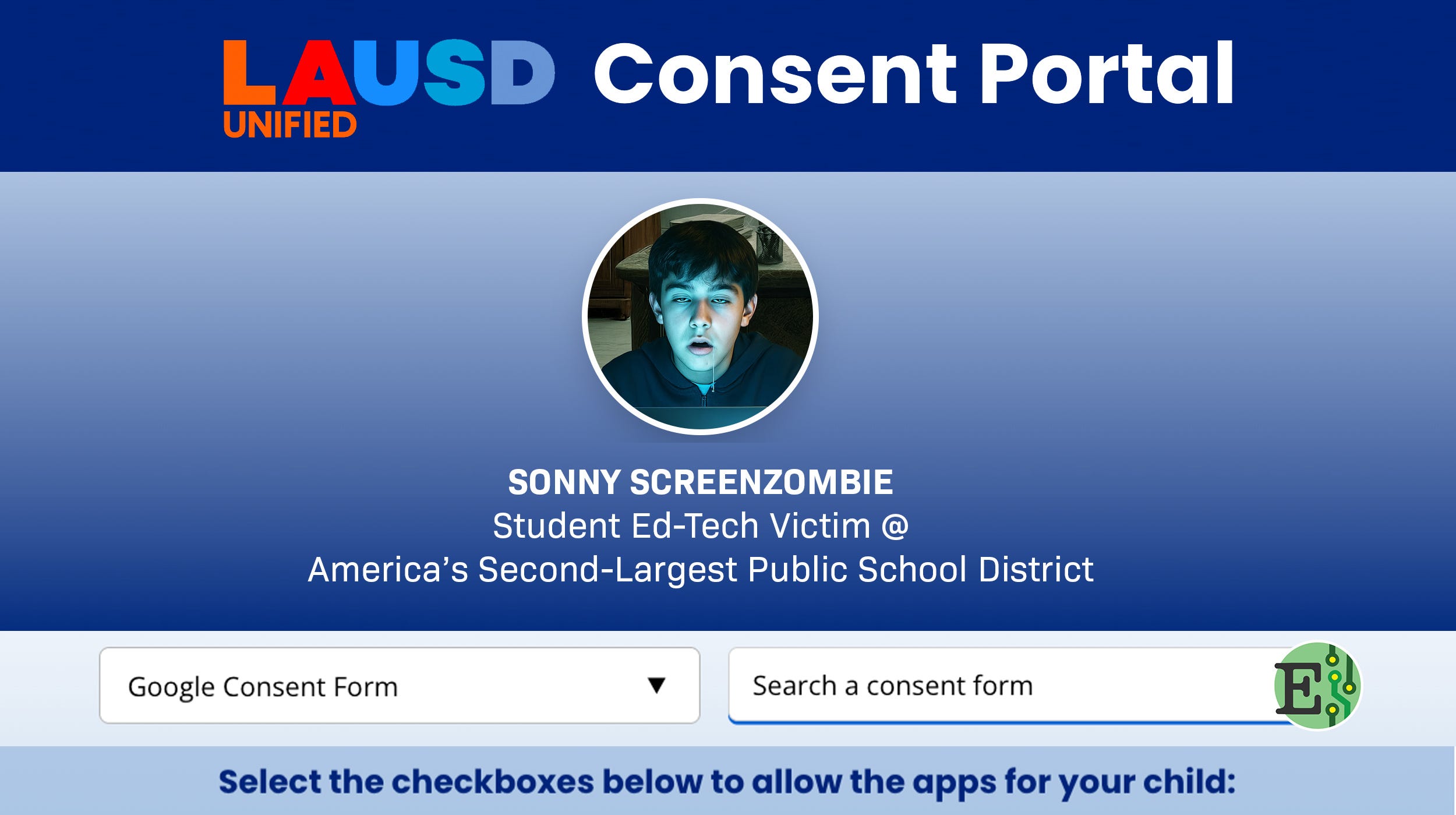
Los Angeles Unified (LAUSD) is setting a bold example for school districts everywhere with muscular new efforts to restore analog classroom sanity for its half-million K-12 students. After years of rubber-stamping the tech-fanboy agenda of disgraced former Superintendent Alberto Carvalho, LA’s school board is repenting under parental pressure — pivoting for the 2026-2027 school year with a strict new screen time reduction policy and other corrective steps towards smothering the ed-tech monster in its crib. Impressively, they’re even kicking things off by taking on the industry’s most entrenched player: Google, whose ed-wares dominate in over 90% of US public school districts.
Two weeks ago, my son started 9th grade at a beautifully modernized LAUSD high school. In a sea change, so far he has reported largely screen-free days, with most of his new teachers happily announcing that their classes will be overwhelmingly paper-based this year. It’s not perfect; worthless i-Ready assessments have already been conducted (he refused them), but no take-home Chromebooks have been issued, and last year’s phone bans remain in effect. Kids are socializing and making new friends. The overall improvement is dramatic — if far from complete.
Chopping Apart the Google Classroom
Especially noteworthy is LA Unified’s shiny new “Consent Portal” website, which deftly unbundles Google’s tightly integrated “Workspace for Education” suite of apps — almost like an antitrust breakup — allowing parents to approve or reject screen-based apps in several district-authored granular categories, which replace Google’s catch-all (and legally self-serving) “Additional Services” consent bucket. This finally puts families in the screen time drivers seat, empowered to reject (at least some of) Silicon Valley’s in-class predation.
What follows is a look at how LAUSD’s new Google Consent Form further breaks apart the Google Workspace/Classroom ed-juggernaut: what works, what’s still concerning, and what choices my family ultimately made. (But hey — you do you!)
Banning YouTube — Finally
Thankfully, one Google service that Los Angeles parents won’t be able to approve or decline is YouTube, which is now blocked and banned for all LAUSD students. One year ago, I wrote about witnessing YouTube reducing Los Angeles classrooms to sheer anarchic chaos in “OK Google, Make Middle School Suck Even More.” The urgency of blocking YouTube from schools cannot be overstated, and LAUSD’s school board is to be applauded for a step that is guaranteed to pay big achievement dividends.
The LAUSD Google Consent Categories
“CORE SERVICES”
What’s Included: Nine products; mostly Google’s familiar cloud copies of Microsoft Office: Docs, Sheets, Drive, Calendar, Gmail, Sites, Tasks, and Classroom.
Evaluation: This is the only category which mirrors Google’s own grouping and labeling. It includes just Google Classroom plus the pragmatic software basics; even for parents wanting to limit classroom screen time as much as possible, these apps remain (for now, anyway) legitimate and utilitarian productivity tools that promote necessary computer literacy.Verdict: CONSENTED. (Besides, this is the software most of us assumed classroom Chromebooks would be limited to in the first place.)
“CURRICULUM & CULTURAL LEARNING”
What’s Included: Google Books, Google Arts & Culture, and Colab (a tool for writing computer code in the Python programming language).
Evaluation: The coding app obviously has no analog equivalent, while Books and Arts & Culture are mere digital library collections. Sure, paper versions of the latter two might be preferable, but the content therein is legitimately educational.
Verdict: CONSENTED.“RESEARCH & REFERENCE”
What’s Included: Google Earth, Maps, Translate, and News
Evaluation: This unfortunate grouping is where things start getting dicey. While Earth, Maps, and Translate are all borderline-magical tech triumphs with legitimate educational value, including Google News is a deal-breaker. That product is an algorithmically-powered third-party content stream, and the quality control for publisher inclusion is virtually non-existent. (I currently have 198 “hidden sources” that I’ve blocked from appearing my Google News feed over the years: fly-by-night purveyors of misinformation, clickbait, tribal rage, salacious gossip, video game drivel, crypto-pumping e-rags, and vacuous search engine content farms.) Consenting to Google News opens the floodgates to in-class gorging on a bottomless buffet of brainrot masquerading as journalism. It’s sheer content distraction.
Verdict: REJECTED. Students can consult an analog map, globe, or atlas, and instant access to Google Translate is obviously problematic in the context of language classes anyway.“DEVICE EXTENSION & 3RD PARTY APPS”
What’s Included: Chrome Web Store
Evaluation: Behold the third rail Trojan Horse! LAUSD claims the Chrome Web Store allows students to install third-party “educational applications necessary to support their learning.” They further assert that students will be limited to apps “reviewed and approved by the District.” No list of apps are provided, nor are the review & approval criteria.
Verdict: REJECTED. Sorry, but even if presently talking a good digital detox game, a district that recently granted children wide-open web access and still chains them to bogus i-Ready online diagnostics must earn trust. Granting any school board carte blanche to jack your kid into undisclosed new software should be a non-starter for all parents keen to keep the ed-tech vultures at bay.
At this point, in the spectacularly unlikely event you haven’t already dozed off, I feel obliged to apologize, because this is officially the most boring thing I’ve ever had occasion to write. Rescue me Lord, for I am literally reviewing a public school bureaucracy’s liability mitigation website form! And yet my inner subversive nerd can’t help but savor this form’s potentially pivotal role in the epic David vs. Goliath struggle now unfolding across the ed-landscape: We Puny Mortals vs. Silicon Valley. And in Los Angeles, the biggest city of the world’s fourth largest economy, Goliath is now losing.
Google Lies About Ed-Tech
Moreover, Goliath (Googliath?) still hasn’t gotten the memo that parents aren’t buying its pitch anymore. In a “Back to School 2026” update posted just last week on the official Google blog, the tech giant crows deviously about the purported validity of their non-core services.
“Across Google Search, Gemini, YouTube, and more, our education tools are built to be safe by design and rooted in proven learning science.”
- Google “Back to School 2026” (August 19, 2026)
That, of course, is a steaming crock of e-shit — and precisely why it is incumbent upon parents everywhere to continue holding their districts’ feet to the fire. In Los Angeles, parent group Schools Beyond Screens has done tremendous work helping steer the school board in a new and sensible direction.
LAUSD deserves congratulations on setting important policy precedents in the initial steps towards undoing its ed-tech train wreck. The momentum looks promising, and if you’re one of LAUSD’s one million parents, you can indulge a glimmer of new hope that what remains of your child’s K-12 education might yet still be salvaged.
If you’re not an LAUSD parent, but suddenly wish you were, well then this is your chance to exploit the infamous herd mentality of the American education community. If your school district remains mired in the Ed-Swamp™, attend a school board meeting, and point to Los Angeles Unified as proof it’s still possible to practice time-tested analog learning in a digital world, and that yes, districts can tacitly confess and repent for unleashing a slow-motion cognitive 9/11 on an entire generation of children.
OK, maybe don’t say the last part. It’s mayhaps a tad too impolitic to be productive. (Besides, they already know, and it keeps them awake at night...)
###
RELATED:


Support EPOSTASY: Buy Post-Tech Swag

About John Allen Wooden:

Howdy. I’m a tech-traitorous writer, satirist, creative director, and dad based in Los Angeles. Having done hard time in big online media, late night TV, ad agencies, politics, and parenting, I created Epostasy as my little lab for gleefully dismembering all those self-important things. Check out my tech-skeptical kids book series, Screen Time Tales, along with other projects at johnallenwooden.com

Thank you John. By the LAUSD making these changes, I’m quite certain they are getting closer to offering the screen-limited, human-centered education that many Google and other tech elite parents are able to offer their kids through access to elite private schools.
This is fricking amazing. I’m blown away by these changes! No chromebooks going home with high schoolers! No YouTube! Parents in the driver’s seat! 👏👏👏