


Note: An alternate version of this essay was first published on UnHerd.
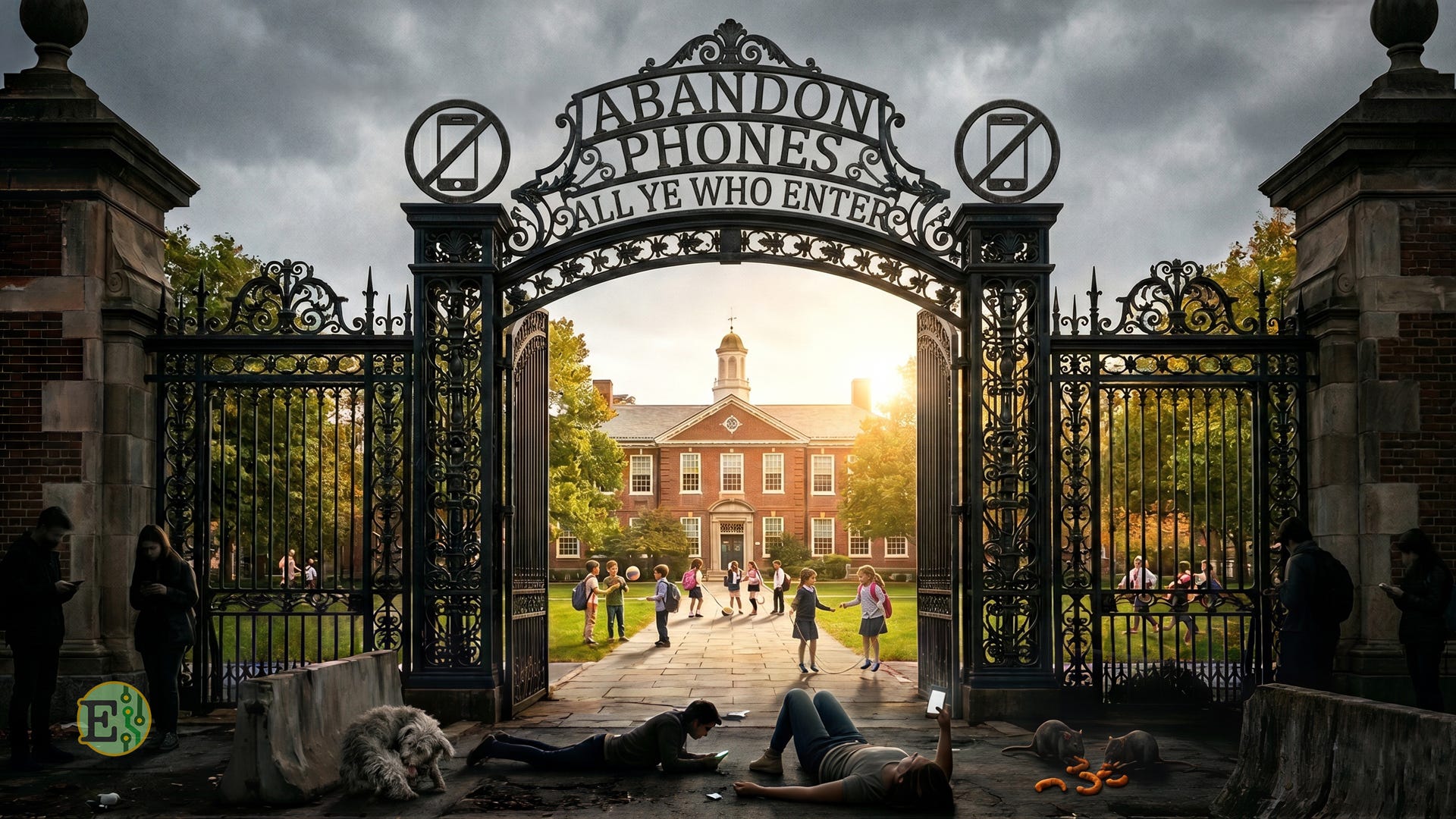
In today’s America, a country cleaved in two by a politics of tribal binary thinking, it sometimes seems a divine act of God is required for any issue to realize overwhelming popular consensus. So there must be a Nor’easter blanketing Satan’s lake of fire in 12 inches of powder, because on the subject of ejecting screens from schools, Americans of all stripes haven’t been this united for a quarter century — since back when both tribes lusted for Osama bin Laden’s head on a spike.
Indeed, with remarkable bipartisan unanimity, the movement to purge phones from classrooms continues to gather momentum, jumpstarted back in 2024 with pols as polar opposite as Gavin Newsom (D-CA) and Glen Youngkin (R-VA) both signing restrictive bans just weeks apart. Fast-forward to 2026, and according to Ballotpedia, 41 US states have taken formal action to limit in-school phone use by K-12 students – and nearly half have embraced public school “bell-to-bell” bans prohibiting phone use throughout the entire school day. So far this year, four states have enacted such policies, and restrictive bills are pending in five more. A 2026 Brookings Institute survey found that 98% of American students now face some level of school phone restrictions, with 55% having all-day bans.
With this no-phones-in-schools train reaching critical velocity, many assume the debate is settled. But alas, one truism of American culture is that even on matters of wide public consensus, there’s a second-guessing phase, when contrarians slither out of the woodwork to peddle cynical, myopic, or self-serving polemics.
A Withering Opposition
School phone ban naysayers may be a fast-shrinking minority, but the surviving die-hards all cling white-knuckled to a few laughably weak arguments. First, a Conspicuous Empathy Brigade insists that screen-deprived students’ academic achievement will suffer due to poor morale. They cite one Texas teenager’s August 2025 petition that garnered over 150,000 online signatures, or a 2026 Pew Research survey indicating 73% of teens oppose full-day bell-to-bell phone bans. (In related news, 73% of kindergarteners oppose asparagus.) Second, Forbidden Fruit Catastrophizers insist that phone ban policies merely make kids “want them more,” resulting in bigger screen time binges at home. My late uncle used similar logic to justify his morning mug of Schlitz.
Third come the clinically paranoid Safetyists, who insist that their 24/7 electronic hovering and smothering is the only thing preventing certain death for little Connor or Sophia. Safetyist parents invariably invoke mass shootings as the nightmare scenario to justify why kids must have phones at school. Because military history is clear: nothing repels war zone bullets so effectively as a panicked phone call from mommy, shrieking “ARE YOU OK???”
On the subject of ejecting screens from schools, Americans of all stripes haven’t been this united for a quarter century — since back when both tribes lusted for Osama bin Laden’s head on a spike.
But perhaps the most corrosive recent second-guessing of phone bans came courtesy of The New York Times. Earlier this year, the Times published the widely-cited “A Blow to the Phone-Free Classroom,” which framed the popular tactic of deploying lockable “Yondr” pouches to enforce school phone bans as a misguided boondoggle. Beneath a heavily Photoshopped illustration of a Yondr bag minced to shreds, the Times painted a grim portrait of a typical pouch: “students destroyed them — leaving them littered in the cafeteria, in bathrooms and on the blacktop — the school was left to pick up the tab.”
The article was co-written by NYT “internet culture” reporters Madison Kircher and Callie Holterman, whose beat hinges on stoking hunger for vacuous online ephemera — and whose recent crackerjack bylines include “What’s With All the A.I. Videos of Cheating Fruit” and “Hey, ChatGPT: Where Should I Go to College?” Their framing characterized the phone ban pouches as a costly “failure” and “an inadequate Band-Aid” — even shoehorning in a decades-old tidbit on “vigorous complaints” about Mayor Michael Bloomberg’s 2007 cell phone ban. This flimsy journalistic narrative was built atop one Los Angeles teen’s anecdotal experience at Van Nuys High School.
Since my kid attends a similar-sized middle school in the same district as Van Nuys, the Grey Lady’s Yondr takedown made me wonder if, despite a year-old phone ban, our school might remain a screen-choked hellscape, where dopamine junkie teens go Edward Scissorhands on their Yondr pouches, and doomscroll openly with impunity. So one recent morning I broke with Los Angeles school drop-off protocol by daring to emerge from my vehicle and see the policy in action for myself.

Yondr Works A-OK, Thanks!
What I witnessed at my kid’s diverse school of 1500 students was a picture of efficiency, not chaos. Aides monitor as tweens pass through Yondr processing stations: slipping their device(s) into the thick neoprene pouches, then locking them with table-mounted magnets before being granted admission to campus. (The process is reversed after the last bell.)
As coincidence would have it, my son forgot his Yondr bag on the morning I accompanied him to the gate. He’s among the last in his cohort to not have a phone, but he does have a cellular Apple watch, which must also get Yondr’ed per the phone ban policy. So when he told a friendly aide named Brian he’d forgotten his pouch, Brian simply stowed the device in a ziplock bag and issued a ticket for end-of-day retrieval.
Brian has worked that gate daily since the ban went into effect early last year, putting him literally on the front line of the screen time battle, so he’s seen plenty of creative efforts by kids to thwart it — from forged parental notes, to second dummy “burner” phones brought as props for phone ban theatre. Nevertheless, he offered a positive take on both the ban and the pouches. “It really does make a difference,” he said, “We don’t really see kids with their phones out anymore.” Still, he acknowledged flaws in the system. “A lot of kids say they don’t have a phone, and I’m not going to be able to check every kid.”
Safetyist parents invariably invoke mass shootings as the nightmare scenario to justify why kids must have phones at school. Because military history is clear: nothing repels war zone bullets so effectively as a panicked phone call from mommy, shrieking “ARE YOU OK???”
But Brian pointed to key implementation rules that successfully keep most kids in compliance for fear of upsetting mom and dad. First is a strict phone confiscation policy. “They know that if they get caught, they’re going to have to give it up so a parent can come pick it up,” he explained. Second is monetary consequences; contrary to the Times’ claim that LA schools “pick up the tab” for student vandalism; at our school, damaging a pouch results in a $40 fine for the parents.
Around the corner at the school’s more heavily trafficked north gate, three more aides stood behind folding tables at a larger Yondr station just inside the chain-link fence. One of them, an amiable young woman named Tory, readily admitted the Yondr pouches aren’t perfect. “There’s good and bad things about everything,” she said, “but this has been pretty good.” Tory went on to describe a sea change in how kids at my son’s school interact post-ban. “We’re seeing a lot less internet drama, cyberbullying — the problems that the phones were causing have gone down like 90%.” After pausing to help a girl whose Yondr pouch’s clasp had bent, Tory added, “the fights have also gone down because kids aren’t recording them and doing it for clout.”
That’s no small difference. At this same school just two years ago, it had become routine for student social media beefs hatched on personal phones during class to explode into physical violence between periods. Scores of kids would surround the melee to record with their phones and post the footage to social media in a mad dash for likes and followers. As a parent, I’d seen (and saved) one of the videos; it looked like a prison yard riot. See for yourself. That scene has not been repeated even once since the phone ban took effect last February.
Ascendant Humanity FTW
But it’s the change in the mundane, everyday rhythms of school that are most obvious. Last year, pre-ban on the same campus, I witnessed a lunch period that was eerily quiet and antisocial, with sedentary kids glued to their phones, wordlessly shoveling food into their mouths. Last month however, I saw a school transformed. During lunch on a sunny California spring day, kids gathered at tables in animated clusters, chatting, telling jokes, and playing with their food. On the fields adjacent the cafeteria pavilion, young teens chased each other, tossed balls, did cartwheels, and trash-talked. A quirky boy wandering solo with a grimy orange traffic cone atop his head approached me and asked with a smile, “Do you like my hat, sir?” Yes, the otherwise idyllic scene was still marred by scattered Chromebooks, but overall it felt like passing through a time portal to pre-iPhone America — with nary a shredded Yondr littered across the cafeteria or blacktop.
My conclusion was that lockable pouches and other restrictions aren’t perfect, and kids can be counted on to stress-test and break rules. But solutions like Yondr largely achieve the desired effect by serving as tangible reminders of the ban — especially when principals implement them bravely, with actual teeth and consequences that put parents on the hook, too.
If screens are a cancer on American education, you might say phone bans were the first round of chemo that halted the tumor’s growth.
Rachel Alonzo, a parent in Jacksonville, Fla., notes that while her two sons already had “pretty healthy relationships” with screens, she approves of the strict school phone bans enacted in their county three years ago — despite having had to collect phones at the school office on the three occasions her boys got caught using them in class. “They enforce it. They mean business,” she said of her sons’ schools, adding, “but rules are rules, you know. They exist for a reason. I’m in full support of that.”
Alonzo and others like her who like the school phone bans are in luck, because at this point, it’s looking like they’re here to stay. The 2026 Brookings Institute study found that over 90% of adults and nearly 80% of teens now support (at least some) restrictions, and other recent surveys from both Pew and Rand show large year-over-year increases in public support for school phone bans. More importantly, the bans are actually making an impact, with schools themselves reporting increased student well-being, higher attendance rates, and fewer fights. Perhaps most interesting, many schools with phone bans are now reporting huge surges in library book checkouts — because apparently, in the absence of screens, kids can still find paper stimulating.
Well Begun is Half Done
Unfortunately, even while the evidence of behavioral and social benefits of school phone bans piles up, there’s been no accompanying bump in academic achievement — with American scores remaining dismal relative to other developed nations. Indeed, in the largest study to date, hot off the presses from the National Bureau of Economic Research (NBER), a survey of 40,000 schools with active bans shows big increases in overall student well-being by year two of phone bans, but also indicates “close to zero” impact on test scores.
Wielding this data, the usual suspects will argue that phone bans are but a pointless moral panic. But standardized testing is a crude measurement tool even when done well, and there is no clinical metric through which to measure the return of a child’s soul.
The NBER study confirms what many parents and teachers already know: when it comes to academic achievement, phones are only half the problem – and the lesser half at that. When phones are banned, students’ gazes merely shift to “digital distractions that are not blocked, such as accessing video or social media sites on laptops”. Indeed, because the core obstacle to learning isn’t the form factor or the owner of the device, it’s the screens and internet themselves, which remain entrenched.
By evicting “private” screens from schools, the phone bans have succeeded in restoring the cafeterias and hallways and playgrounds to healthy, human-centric settings. But back in the classrooms, state-issued screens wrapped in a false cloak of educational legitimacy remain atop every desk — merely consolidating all the dopamine-spiking distractions onto Chromebooks and iPads running unproven, ineffective ed-tech platforms like the widely loathed i-Ready.
So yes, the school phone bans are popular — and they’re working — but they’re not a magic cure. If screens are a cancer on American education, you might say phone bans were the first round of chemo that halted the tumor’s growth. But for any true rebound in academic achievement, we’ll need radical resection surgery on the Chromebooks and iPads, followed by a blast of radiation targeting endless online standardized tests. Then, and only then, can we expect to see the malignancy of imploding youth cognition put into long-term remission.
###

About John Allen Wooden:

Howdy. I’m a tech-traitorous writer, satirist, creative director, and dad based in Los Angeles. Having done hard time in big online media, late night TV, ad agencies, politics, and parenting, I created Epostasy as my little lab for gleefully dismembering all those self-important things. Check out my tech-skeptical kids book series, Screen Time Tales, along with other projects at johnallenwooden.com

John, this is cool. I think hiding behind many "concerned" voices is a lot of big money invested in keeping screens of all sorts in school.
The school I work at went bell to bell no cell a year and a half ago and I too saw the change in the hallways and at lunch. Teachers are no longer battling the personal device distractions- and several have voluntarily closed the lids on the chromes and gone back to pen and paper. Kids groaned but after a few weeks were fine with it. Intentional use of screens … that’s simply the solution. We plan to ditch the 1:1 assignment of Chromebooks next year and go back to grabbing from the cart only when it makes sense. I bet there will be some who were using the CB as a personal device replacement who will get the jitters for a few weeks and then … purposeful learning will return.