


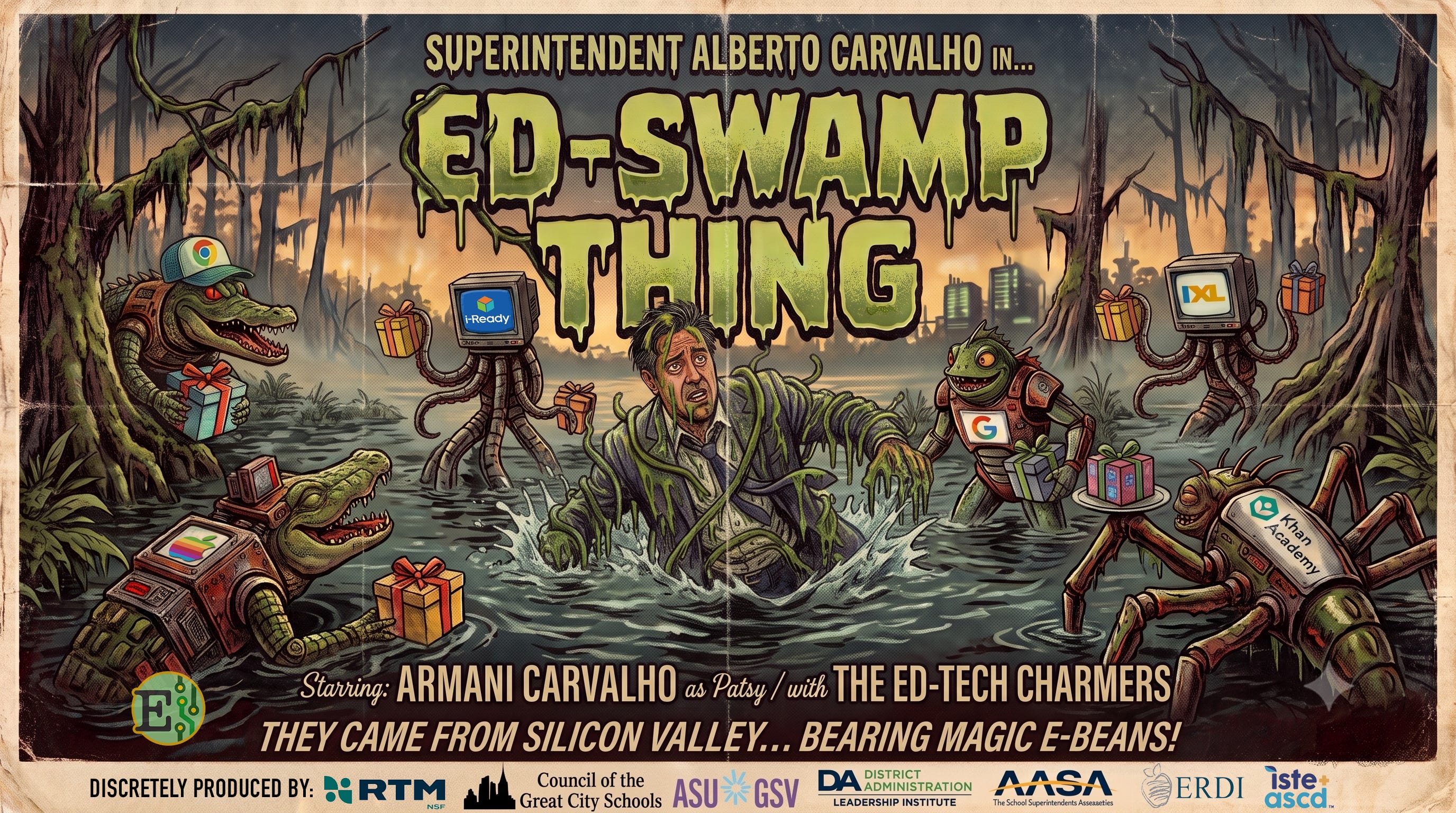
For sales people in the education technology (“ed-tech”) biz, there is no juicier quarry than the gullible superintendent of a big city school district. With czar-like dominion over multi-billion dollar budgets and the pedagogical vision for hundreds of thousands of students, an urban superintendent — when expertly seduced at a swanky education conference or private executive retreat — is the ultimate fast track to inking sweet eight-figure procurement contracts.
And so it was with Alberto Carvalho, who from 2008-2026 served as the immaculately manicured Superintendent for not one, but two of America’s top five school districts. During his reigns at Miami-Dade and LAUSD, Carvalho aggressively cultivated a pro-tech “digital innovator” personal brand that netted him five “Superintendent of the Year” honors and multiple trips to the White House. But last month it all came crashing down, when Carvalho resigned from LA Unified in disgrace following FBI raids on his home and office to investigate unseemly financial dealings with AllHere, an AI ed-tech vendor.
Carvalho may be the most prominent administrator brought low by dicey entanglements with Big Tech, but he will almost certainly not be the last. That’s because today’s superintendents dwell in a professional landscape I do hereby dub “The Ed-Swamp™” — an ethically brackish bog where glitzy private conferences and summits serve as lily pads for Silicon Valley sales toads, who croak sweet ed-tech nothings into superintendents’ ears while locking in unfettered predatory access to America’s children.
Super Supremacy
The public doesn’t give much thought to school superintendents; we know they’re major bureaucrats and, um, yawn. But we should, because a big city super’s power actually eclipses that of most mayors — and more than a few governors. At Los Angeles Unified, America’s second-largest district, Alberto Carvalho controlled an annual budget of around $20 billion. That’s more than the entire annual state-wide operating budgets of New Hampshire, Idaho, and both Dakotas — combined.
During Carvalho’s tenures at Miami-Dade (2008-2022) and Los Angeles Unified (2022-2026), the Superintendent became a veritable ed-tech zealot — spending lavishly in tireless pursuit of his vision to replace books, paper and chalkboards with screens. Unfortunately for the 2 million children enrolled under his watch, Carvalho succeeded, making chaos-sowing 1:1 devices and unproven e-learning slopware like i-Ready standard in classrooms. But as a suave public education celebrity, Carvalho’s influence extended far beyond Miami and LA; he’s been an influential poster boy for normalizing screen-based schools for a generation of American kids.
Before his June 21st resignation from LAUSD, Carvalho had been in limbo for four months, banished by the seven-member School Board to an ignominious paid leave while it initiated a review of all his ed-tech contracts. It was a head-spinning turn of events for the superintendent, who for years had enjoyed slavish board support, with swift rubber-stamp approvals of his budgets and a unanimous vote to extend his contract just weeks prior. But the FBI dragnet instantly rendered Carvalho a radioactive pariah; he received nary a word of post-raid public support from LAUSD.
At Los Angeles Unified, America’s second-largest district, Alberto Carvalho controlled an annual budget of around $20 billion. That’s more than the entire annual state-wide operating budgets of New Hampshire, Idaho, and both Dakotas — combined.
That’s because school board members, after all, are publicly elected officials — and like all craven politicos, their true priority is ensuring they get reelected. (In Los Angeles, a school board seat pulls a starting base salary of $127,000, plus a veritable buffet of juicy taxpayer-funded health and retirement benefits.) So when a board’s hand-selected Superintendent is investigated for malfeasance under their supposed oversight, they will more often than not promptly toss the accused under the school bus. While Carvalho has still not been charged with any crime, and publicly voiced his desire to return to work, the LA Times reported the board had recently threatened termination — effectively forcing his resignation.
But in a much more ominous development for Big Ed-Tech, the day after Carvalho’s resignation, that same previously submissive board unanimously approved a new policy strictly limiting in-school screen time. This represents a very public repudiation of Carvalho’s entire tech-driven philosophy, tenure, and legacy. The new LAUSD policy, while woefully inadequate (more on that another day), acknowledges the inherently harmful nature of screens on child health and cognition, and represents the first phase of a profound course correction away from granting the ed-tech industry carte blanche to demolish analog schooling.
Compounded by a growing movement of parents demanding tech be purged from classrooms, increased scrutiny of ed-tech’s self-authored science-washing, and the new US Surgeon General advisory on the harms of digital devices, the Carvalho era of peak screen orgy classrooms now appears squarely in the review mirror.

An Ed-Swamp Most Slimy
America’s Superintendents weren’t born with ed-tech religion. They get converted. And a primary vector of conversion is via education conferences and private retreats, which unbeknownst to the general public, today bear zero resemblance to the quaint, tweed-swathed academic powwows of our yesteryear imaginations.
Today we have an Ed-Conference Industrial Complex, a multi-billion dollar sector dominated by a motley crew of venture capitalists, B2B events conglomerates, and Big Tech fronts. In their hands, education conferences have mutated into glorified corporate bordellos, where big-budget superintendents are lured with ego-stroking VIP invitations and luxury perks, then pimped to the highest corporate bidders.
Now you may be thinking, “But all conferences are big palm-greasing hustles; that’s just how American business gets done.” Fair enough; conferences have a legitimate role to play, and not every large transaction between the private and public sectors should set off conspiratorial, anti-capitalist alarm bells. School districts must spend heavily to function, and so superintendents are obligated to find reliable providers of necessary goods and services. Books and pencils won’t buy themselves. (Or get bought at all in the 2020s.)
Education conferences have mutated into glorified corporate bordellos, where big city superintendents are lured with ego-stroking VIP invitations and luxury perks, then pimped to the highest corporate bidders.
That may all be true, but another unfortunate truism of American capitalism is that big money attracts big shadiness. And according to the Bureau of Economic Analysis (BEA), the public school sector ranks firmly as a Top 10 U.S. industry by revenue — well above airlines, fast food, and automotive. So perhaps that’s why, as you’ll see, many major education conferences stand out as, well, remarkably sleazy — even by present-day lawless kakistocracy standards.
Perhaps the most stunning recurring theme in modern education events marketing is the flagrant direct sale of access. Ed-conference organizers corral school superintendents like chunky, wriggling koi in a Four Seasons lobby fountain, then brazenly auction harpoon guns to “partners,” who — shocker! — are overwhelmingly ed-tech vendors, snaring facetime with supers in VIP rooms, golf carts, and posh restaurants.
If that sounds like hyperbole to you, take a peek at just three of the dozens of big conferences on the Superintendent Circuit:
1. National Superintendents Forum (NSF)


Produced by: RTM Business Group, LLC.
Held four times per year at luxury waterfront hotels and golf resorts replete with spas and fine dining, the National Superintendent Forum strictly limits attendance to vetted top-tier administrators who control enormous budgets. For their upcoming September 2026 gathering, they promise that paid “partners” will enjoy “Guaranteed 1:1 Meetings” with 80+ superintendents in attendance. The 23 publicly listed superintendent speakers currently preside collectively over 400,000 to 500,000 students. RTM pays travel and accommodation costs for all invited speakers, and does not release lists of its sponsor “partners.”
2. District Administration Leadership Institute (DALI)


Produced By: District Administration
The exhaustingly named District Administration Leadership Institute is the event-hosting arm of powerhouse K-12 trade rag District Administration, a glossy print magazine and daily digital newsletter delivered free of charge to every superintendent in America. Its year-round circuit of private summits, held at tony resort destinations, sells “partners” facetime with “a captive audience” of superintendents and other budget-controlling decision-makers. DALI advertises its summits to qualified superintendents with complimentary lodging, all meals provided, and up to $400 in direct travel reimbursement. In exchange, “partners” get to schmooze, nosh filet mignon, hit the golf links, or hang commando in the sauna with superintendents like Alberto Carvalho — a former DALI fixture.
3. National Conference on Education (NCE)


Produced by: School Superintendents Association (AASA)
Widely regarded as the top annual convention for superintendents, the National Conference on Education draws over 4,000 K–12 system leaders from all 50 states. With its traditional trade-show format of corporate vendor booths in a sprawling exhibit hall, NCE may seem ostensibly less unctuous than NSF and DALI.
Nonetheless, NCA also promises corporate sponsors “access to education decision makers” with “enormous buying power.” Far worse, AASA even sells an Orwellian “Digital Retargeting” package — powered by digital tracking cookies dropped on Superintendents’ personal devices by the event’s website — that enables sales vultures to circle their carrion indefinitely after the event ends, delivering targeted programmatic advertisements “day in and day out, as they browse the web on popular sites they use every single day!” (Imagine your TikTwit feed smothered in ads for Digi-Smartz® and e-Lurnr.ai®.)
The Banality of Conspicuous Grifting
The role of the Ed-Conference Industrial Complex in ed-tech’s conquering of American classrooms cannot be overstated. These events aren’t outliers. They are the Ed-Swamp norm in the 21st century, when high-profile superintendents can literally attend a different luxury networking event almost every month on the dime of ed-tech “partners.” Alberto Carvalho was a regular at these and many other conferences, including Global Silicon Valley (ASU+GSV), where his Big Tech sycophancy was routinely on vivid display — despite his also being fundamentally a tech rube.
Conference organizers corral superintendents like chunky, wriggling koi in a Four Seasons lobby fountain, then brazenly auction harpoon guns to “partners,” who — shocker! — are overwhelmingly ed-tech vendors.
In fairness to Carvalho, for all his complicity in Silicon Valley’s assault on Gen-Z cognition, he’s just the lavishly hair-sprayed tip of the iceberg, and hardly the first Superintendent to get fatally puppeteered by the ed-tech industry. In 2014, his LAUSD predecessor John Deasy also resigned in disgrace due to a federal investigation into his disastrous 1:1 iPad procurement program. In 2019, Metro Nashville Public Schools terminated the contract of Superintendent Shawn Joseph for improperly steering public money to multiple ed-tech companies via no-bid contracts. Two years later, Pittsburgh Superintendent Anthony Hamlet was forced out after an ethics probe highlighted major ed-tech conflicts of interest, including pocketing ed-conference honorariums and accepting a private jet trip to Cuba from an ed-tech vendor.
And as far back as 2017, a New York Times exposé by Natasha Singer and Danielle Ivory explored how ed-tech companies cozy up to superintendents at closed-door luxury ed-conferences hosted by ERDI, an RTM competitor. Baltimore Superintendent S. Dallas Dance was revealed, among others, to have extensive ethically dubious dealings at these events with various ed-tech companies, including i-Ready publisher Curriculum Associates. The NYT investigation ultimately led to Dance’s indictment and 2018 prison sentence for perjury.
After that Times exposé sent shockwaves through the Ed-Swamp, event producers like ERDI, RTM and DALI discontinued cutting personal “honorarium” checks to superintendents for attendance, and rebranded their 1:1 sales pitch rooms as “research and development” and “partnership” opportunities. But despite these cosmetic ethical overhauls, the core “captive audience” business model of the Ed-Conference Industrial Complex remains intact. Indeed, ed-conference producers have cemented their role as laundering intermediaries: after collecting sponsor fees, the event organizers fund the superintendents’ luxury lodging and travel stipends, providing the administrators a “third-party scholarship” legal shield from pesky procurement watchdogs and grand jury probes.
Today, the nakedly unethical canoodling of American superintendents and the ed-tech industry remains an epic scandal hiding in plain sight. Vanishingly few Superintendents are 100% clean — including yours, wherever you live. Most have phones filled with Ed-Swamp “partner” contacts from Google, IXL, Curriculum Associates, PowerSchool, etc. — and very few, if subjected to the same US Department of Justice proctoscopy given Carvalho, could possibly emerge unscathed.
As for Carvalho, the Ed-Tech Icarus? However disastrous his tenures, his underlying commitment to the ideals of education and public service were admirable. He worked hard, too — unfortunately at doing exactly the wrong things. But it makes one wonder: what truly great things might Carvalho have accomplished for city kids had he never been bewitched by Silicon Valley’s snake oil sirens? We’ll never know — and as things stand, history will not be kind; Alberto Carvalho will be remembered as ed-tech’s #1 patsy — the guy who championed exiling books from schools and shackling children to glowing rectangles instead of teaching them like human beings.
But don’t worry too much about Alberto. Given his decades of fruitful frolicking in the Ed-Swamp, and the shameless revolving door relationship between public education administration and Silicon Valley, we can probably expect news of a lucrative new ed-tech gig for Carvalho in three… two… one…
###
Support EPOSTASY: Buy Post-Tech Swag

About John Allen Wooden:

Howdy. I’m a tech-traitorous writer, satirist, creative director, and dad based in Los Angeles. Having done hard time in big online media, late night TV, ad agencies, politics, and parenting, I created Epostasy as my little lab for gleefully dismembering all those self-important things. Check out my tech-skeptical kids book series, Screen Time Tales, along with other projects at johnallenwooden.com

Thank you, John! We need to keep exposing the tech industry influence in education!!
John, this is one of the most well-written pieces on kids' tech I have ever seen--thank you for letting us see all that lurks in the swamp. This smacks of 70s-era mafia-run Las Vegas business contracts being handed out, not the scientific decision making which should be informing our kids' education.