


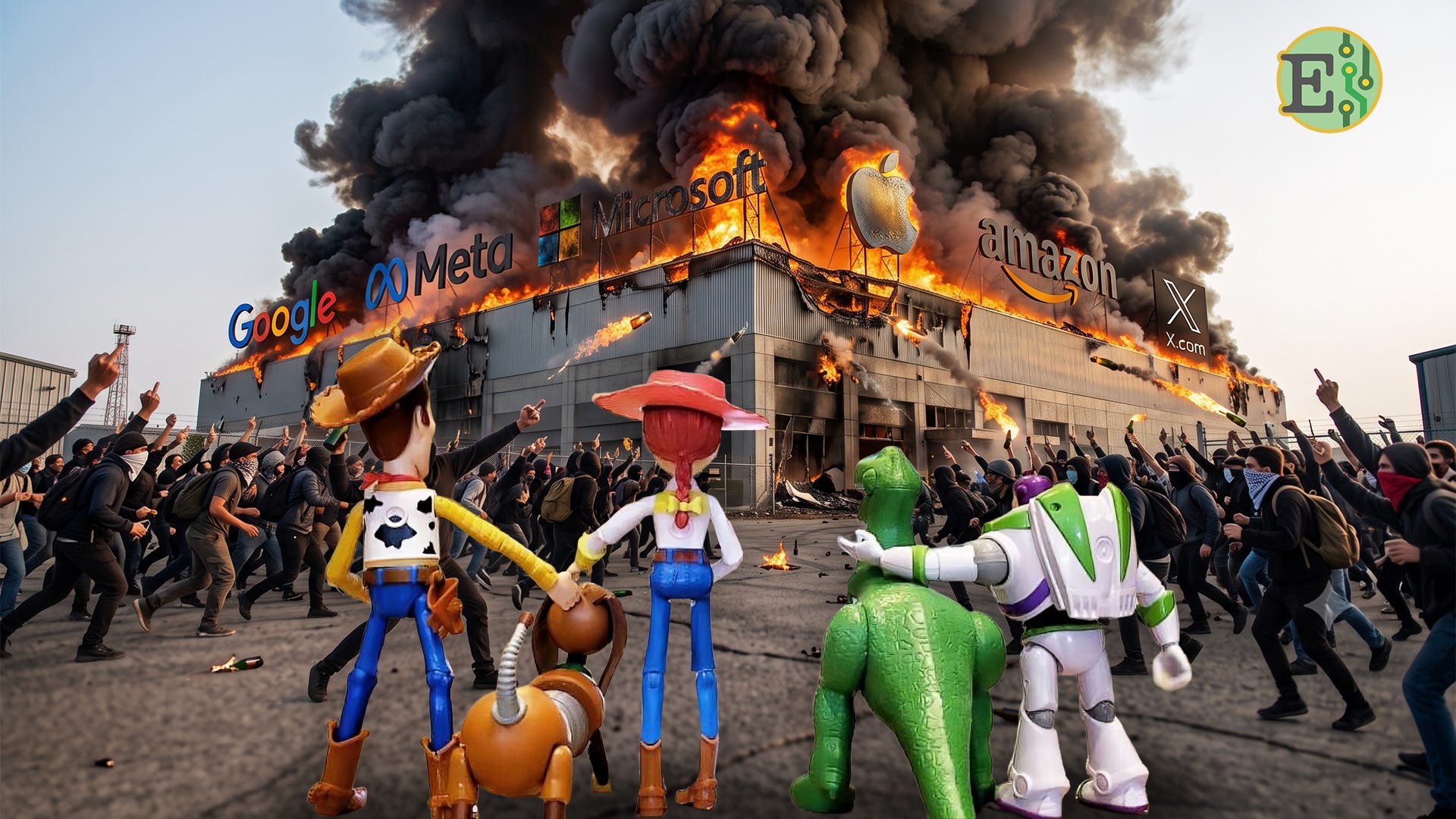
If there was ever any doubt that Big Tech’s PR problem is swelling like an engorged tick, one need look only to last weekend’s $312 million global debut of Disney’s Toy Story 5, directed by Andrew Stanton. That film’s marketing campaign — which featured beloved franchise stalwarts Woody, Jessie, and Buzz cowering in fear behind a villainous tablet computer named Lilypad — resonated so deeply around the world, it propelled the sequel to a stunning blockbuster launch, securing the biggest three-day cash haul in the 31-year history of the Toy Story franchise.
This isn’t a movie review. I’ll leave the opining on filmmaking to the showbiz fanboys. No, this is an acknowledgment of a remarkable cultural watershed moment — when a film’s mere theme propelled it to the top of the charts by offering a catharsis for the screen-induced digital malaise that grips our species. TS5’s tagline is “The Battle for Playtime Begins,” and indeed, its success represents an ominous societal artillery shot across the bows of Big Tech’s armada. Silicon Valley would do well to pay attention.
Because when is a kids summer movie not just a movie? When it makes its central villain a transparent personification of the most lucrative and omnipotent industry of its era. Imagine if in 1937, Snow White’s sadistic nemesis wasn’t a wicked queen, but a shiny simulacrum of US Steel’s Andrew Carnegie. Or imagine if in 1942, Bambi’s mother had been mowed down by a steam locomotive, prompting Thumper and Flower to join the fawn’s epic struggle against the Pennsylvania Railroad. Those films would have bombed and been promptly forgotten — all for lack of credulous villains. Their yesteryear audiences didn’t perceive the biggest industries of their times to be rapacious, immoral cabals; they saw them as legitimate engines of economic and societal prosperity. Flawed perhaps, but certainly not inherently villainous.
For audiences in the screen-addled 2020s however, there’s no need to imagine Big Tech’s villainous intent and outcomes — because we see it in our own lives each and every day. We see ourselves tracked Big Brother-style and monetized like chattel via overpriced and rapidly obsolescent gizmos, our nations torn asunder by tech-induced tribal rage. And yes, we see our own children in Toy Story 5, subsisting in a version of childhood that has been eviscerated and warped by Big Tech into something heartbreakingly hollow and inhuman.
Because when is a kids summer movie not just a movie? When it makes its central villain a transparent personification of the most lucrative and omnipotent industry of its era.
Of course, Disney has waded in tech-averse waters before. You might say 2008’s WALL-E was the progenitor of TS5. Also directed by Andrew Stanton, that dialogue-free tableau of a tech-saturated future dystopia is already proving eerily prophetic, with its depiction of humanity devolved into a race of grotesque, larval screen zombies tended by robotic AI minders. But where WALL-E felt like distant sci-fi fantasy in 2008, Toy Story 5 bows as a reflection of our grim, lived reality in 2026.

So how does the 30 year-old Toy Story franchise actually handle Big Tech? Not with kid gloves. Out of the gate, toy-loving child protagonist Bonnie is contrasted with twin antisocial screen junkie brats who live across the street. When friendless Bonnie’s parents, desperate to alleviate her aching solitude, relent and buy her the “Lilypad” tablet which is de rigueur for her age group, she’s transformed overnight into a toy-rejecting, hypnotized dopamine addict, prompting Wallace Shawn’s dinosaur character “Rex” to moan, “Extinction – not again!”
Overall, Toy Story 5 serves up a devastating (and painfully accurate) portrayal of contemporary screen-based childhood. The camera pans across entire neighborhoods where seemingly every window frames a shut-in, catatonic child bathed in blue screen light. Play dates and sleepovers are likewise played as the bleak affairs they’ve become, with kids tapping wordlessly at tablets in parallel. This isn’t a post-apocalyptic fantasy; it’s banality-as-horror cinéma vérité. Or as Tom Hanks’ “Woody” laments, “Toys are for play, but tech is for… everything” — eliciting a groan from TS5’s heroine, Jessie.
Mind you, Pixar does hedge its critique — perhaps self-conscious of its own Big Tech roots and having pioneered the CGI that decimated the art of analog 2D animation. In the process, TS5 pulls a few punches. Yes, Lilypad is largely depicted as a smug, duplicitous, hubristic monster intent on devouring every moment of Bonnie’s attention (a faithful representation of Silicon Valley product development and business practices!), but Pixar abstains from taking this tech-bashing polemic to its logical conclusion.
Given Big Tech’s outsize destructive role in contemporary childhood, some of us would prefer that Lilypad’s character arc more resemble that of Lotso, the villainous purple teddy bear of Toy Story 3, who remains incorrigibly horrible until the bitter end. While Lotso gets deliciously dark karmic justice via crucifixion to the radiator of a garbage truck, doomed to choke on diesel exhaust and insects for eternity, Lilypad is granted a reprieve — and even a seat at the dollhouse table. Towards the end, Lilypad accepts how damaging her impact on Bonnie has been, and in a not-so-kiddy-appropriate twist, the guilt-racked device attempts suicide by hurling herself into a donation box. This ultimate penance earns her partial redemption; Lilypad then helps in the quest to land Bonnie an IRL friend, and is admitted to a lower tier of the toys’ inner circle, with Woody declaring her “one of us.”
Toy Story 5 serves up a devastating (and painfully accurate) portrayal of contemporary screen-based childhood. The camera pans across entire neighborhoods where seemingly every window frames a shut-in, catatonic child bathed in blue screen light.
It feels like Pixar is strategically tempering its inclination to go scorched earth, lest it alienate the millions of ticket-buying parents who feel helpless and overwhelmed by the domination of tech in their families’ lives. That’s a bridge too nuanced in my book, but it’s grounded in a certain pragmatic empathy that is, at least, forgivably humanistic.
Less forgivable is the Toy Story 5 product line brought to us by Disney’s consumer products group, a division so shameless, it sells 10 cents worth of pipe cleaners, googly eye stickers, and a flimsy plastic spork as a $40 “Forky” toy. I’m guessing TS5’s Director Andrew Stanton, with his impressive track record of thoughtfully tech-averse narratives, was plenty chagrined to learn that Disney granted some truly cringe-inducing licenses for his latest installment. The official $50 Lilypad iPad case by Belkin literally wraps unhealthy screen time in a cutesy TS5 package, and in a supernova of irony, a $30 electronic Lilypad toy for toddlers, replete with texting and apps, is produced and sold by Leapfrog — the exact company that Lilypad is parodying in the film. Talk about perverse cultural appropriation.


Hypocritical merchandising and minor hedging notwithstanding, TS5’s strident POV remains crystal clear. Online, some loud voices (mostly ones on Big Tech’s payroll) will complain it’s heavy-handed. Perhaps, but as of this writing, it’s a winning and in-demand message, with TS5’s daily take still surging on BoxOfficeMojo, positioning it to win the summer kids box office — and perhaps the adult one, too.
Toy Story 5’s huge success represents a mass cultural repudiation of Big Tech’s impact on kids. It’s a proverbial analog beer truck in the digital desert, the cinematic equivalent of the furious anti-tech boos confronting AI-boosting speakers at college commencement ceremonies. Indeed, you might even say that for Silicon Valley, Toy Story 5 is its Walter Cronkite on Vietnam moment: an inflection point, a fundamental and inexorable shift in public opinion — the furious awakening to the reality that we’ve all been duped by dishonest, borderline sociopathic actors. Toy Story 5 is breaking box office records not simply because audiences are buying tickets for a movie; it is because they are voting with their wallets for a version of childhood that still goes “to infinity and beyond” — and requires no stupefying glowing rectangles to get there.
By cracking the code on how to monetize public loathing of Big Tech, Toy Story 5 is making a killing. And where there are mega-profits, mega-imitation is sure to follow. So buckle up, Silicon Valley. Your visit to Sid’s bedroom has only just begun.
###
About John Allen Wooden:

Howdy. I’m a tech-traitorous writer, satirist, creative director, and dad based in Los Angeles. Having done hard time in big online media, late night TV, ad agencies, politics, and parenting, I created Epostasy as my little lab for gleefully dismembering all those self-important things. Check out my tech-skeptical kids book series, Screen Time Tales, along with other projects at johnallenwooden.com

MORE BIG TECH LOVE:
Mark Zuckerberg: Nuclear Terrorist

Last month, glistening android Mark Zuckerberg announced deals that will see his company Meta fund the construction of multiple new nuclear power plants. The facilities—each capable of illuminating entire cities—will instead be devoted exclusively to powering “Prometheus,” the CEO ’s megalomaniacally-named supercluster data center co…
Thanks John. I'm interested to see where this takes us. The tech-repudiating childhood has been the goal of many tech elite parents for some time. What does it mean when mainstream Disney communicates this message?
The modern American family didn't just naturally drift toward screens—it was subjected to a coordinated, structural override. The Left used educational policy to isolate the child from the parents, and the Right deregulated the tech industry to sell that isolated child to the highest bidder. The result is an $11 billion annual harvest of the adolescent retina. We traded the American living room for a digital Skinner box. Read the full structural breakdown of how state policy and Big Tech domesticated our kids:https://triggledger.substack.com/p/captive-audience-the-unregulated?utm_source=share&utm_medium=android&r=8gc1qf