


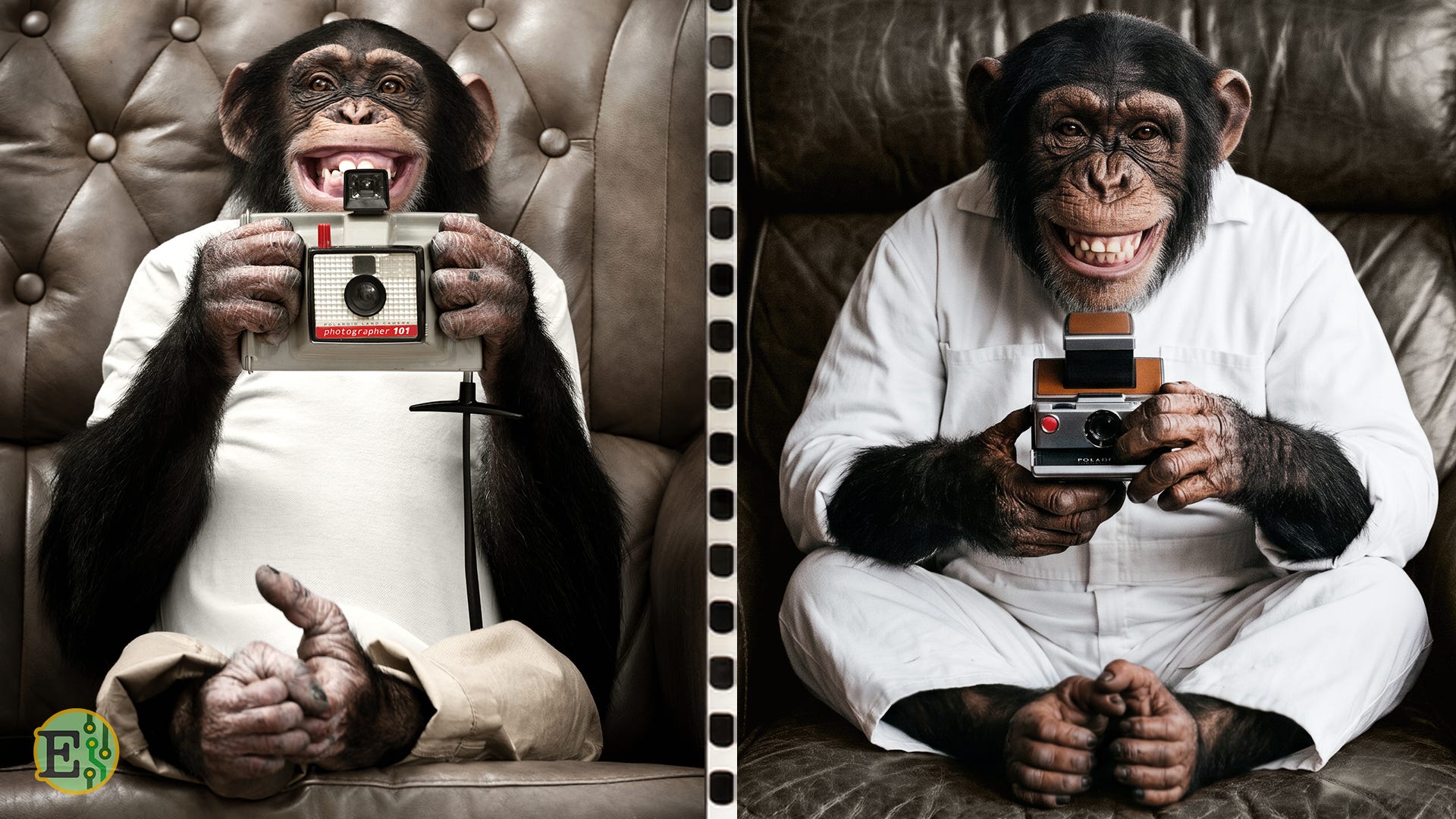
Last week, the online photo licensing giant Getty Images filed for bankruptcy. Founded in 1995, Seattle-based Getty has enjoyed an epic run, but increasingly looks poised to go the way of the Dodo — another pillar in the temple of human artistry being carpet-bombed by soulless A.I. drones. Sadly, in an era where chatbots can instantly vomit out virtually perfect slop of whatever your noodle can dream up, the business model of paying for visuals generated by us camera-toting primates is pretty much toast.
I have complicated feelings about this. As a photography lover and creative pro who’s done time across many sectors of media, I’ve licensed Getty assets for countless projects over the years. I even remember using many other services that Getty has since gobbled up: PhotoDisc, Archive Photos, Image.net, etc. That rapacious scale has long made Getty both a blessing and a scourge for anyone working in creative roles — an indispensable one-stop resource, yes, but also overpriced and tediously rigid in its usage limits.
Still, fundamentally Getty has been an ally to human creativity. It has provided an invaluable service to the creative community — making untold gazillions of visuals instantly accessible at the click of a mouse. It has also ensured photographers are compensated for their work, and democratized the field by empowering unknown, aspiring creators to upload their output for monetized licensing via its platform. This sparked a vibrant new economy, with photographers around the world generating speculative, lavishly polished imagery for every conceivable editorial and marketing need — however ultra-niche or even bizarre.
In fact, photographers’ collective output became so voluminous and imaginative, at one online magazine I produced for a big legacy media outfit in the mid-aughts, our editorial team created a popular “Insane Stock Photos” running feature to highlight the sheer hilarious absurdity of it all: from heat-packing cat ladies to corny corporate douchery to, um, deeply perplexing boudoir tableaus. On one hand, that wellspring of visual product was a glorious manifestation of humanity’s limitless imagination and industrious spirit, but on the other, it was symptomatic of the rapid commodification of the image — a harbinger of the A.I.-scraped implosion to come.
Sadly, in an era where chatbots can instantly vomit out virtually perfect slop of whatever your noodle can dream up, the business model of paying for visuals generated by us camera-toting primates is pretty much toast.
As the glut of quality stock imagery grew, the first casualty was the bespoke professional photo shoot — a previous mainstay of media production. Increasingly, instead of booking an expensive photographer and studio time, I found myself clicking over to Getty. By the late-aughts, multiple pro photographers I knew had reluctantly thrown in the towel to pursue other careers. One lamented to me, “my images are now worth pennies on the dollar to what they were just a few years ago.” Alas, in the A.I. era, that slow-swinging creative wrecking ball has become a whirring chain mace, and I confess to contributing to Getty’s current financial pickle.
Most recently, after paying a monthly subscription to Getty’s iStockPhotos for umpteen years, I cancelled it in 2025. Why? Because overall, GenAI photos are now as good as generic stock — and for creatives on deadline, mayhaps a bit better. Look at the two chimps atop this page. Can you tell which is the real Getty image? Yeah, I can too — but only if I pause to really scrutinize, despite the Getty image (on the left) costing thirty times more. So which one would I pick if I started producing some crappy new ad campaign tomorrow? Much as it pains me to say, probably the A.I., and not just because I’m a penny-pinching tech whore.
The truth is that using stock photo/video has always meant settling for something less-than-ideal. Most creative directors will tell you we already have a crystal-clear vision of a desired visual before ever searching a resource like Getty: the subject, style, lighting, composition, etc. Unfortunately, even if you’re lucky, a typical stock media asset might be 68% in sync with your vision. But suddenly, with a well-written prompt, GenAI visuals can get you to 91% — basically for free. That’s why A.I. images have largely replaced stock in projects for so many creative pros. (Mind you, I’m so anal, whether I’m using human-made or GenAI stock, I still spend hours in Adobe programs tweaking and recompositing to achieve my desired 100%.)
But even this reality shall not last. Because in the span of five short years, we have gone from A.I. images that looked like grotesque hallucinations, to realistic-but-flawed eight-fingered facsimiles, to the present: where the A.I. tells are increasingly hard to discern — even for those of us who can spot a stray pixel from twenty paces. At this rate of advancement, A.I. photography will be indistinguishable from true photographs in just a year or two.
History abounds with antecedents to A.I.’s decimation of photography: like what typesetting did to calligraphy, green screens to hand-painted set backdrops, or Kanye West to melody.
As much as I’ve always loved stock photography, I’ll concede it’s a lower art form — what Hallmark greeting cards are to epic poetry, or Kraft Easy Mac is to haute cuisine. So maybe we needn’t mourn stock. Perhaps it was fated to be displaced, much as photography largely obliterated the artistic tradition of formal oil portraiture — itself once a load-bearing pillar of that temple of human artistry. History abounds with antecedents to A.I.’s decimation of photography: like what typesetting did to calligraphy, or green screens to hand-painted set backdrops, or Kanye West to melody. That’s not automatically a bad thing, either. Without the disruption of photography, painting might never have evolved to give us impressionism, surrealism, or pop art. Imagine poor Andy Warhol doomed to painting Baroque frescos of Nancy Reagan!
And that’s why even some A.I. skeptics agree with the blathering A.I. boosters who insist that A.I., in eviscerating demand for commodity human-produced stock photography, might spark a renaissance for prestige photography. They theorize that once A.I. liberates humanity from the drudgery of commercial creativity, we’ll be empowered to pursue our authentic muses and achieve new heights of capturing the beauty and nuance of the meat puppet experience. So could it be that A.I. will somehow indirectly birth the next generation of trailblazing, genre-spawning photo geniuses to rival Diane Arbus or Joel Peter Witkin? (Yeah, I like the weird ones.)
It’s a nice enough utopian fantasy, but no, it won’t. That’s because photography is like no other visual art; it exists at the intersection of art, engineering, and science — merging the aesthete’s eye with the engineer’s aperture and chemist’s flash powder and dark room potions. Its purpose has never been merely to tickle the eye; it’s also to capture reality. Sure, it’s long been imperfect that way — from Josef Stalin’s primitive Ministry of Truth photo manipulations, to the staged second flag-raising at Iwo Jima, to the past quarter century of ubiquitous Photoshopping. Nevertheless, culturally we still subscribe to the assumption that each photograph, in its core essence, contains at least some kernel of physical truth. That’s why “the camera never lies” truism has long been a binding thread in the fabric of society. A.I. shreds that fabric to lint — forcing a disorienting paradigm shift by completely divorcing photo-real visuals from any real-real subjects for the first time in human history.
As a college undergrad studying culture and media, I was forced to read postmodern theorists like Roland Barthes and John Berger, who wrote at (tortured) length about the meanings of images. I loathed their unintelligibly convoluted and pompous prose, and yet now can’t help think they were prescient in challenging the idea of images as objective windows into reality. If either of those Eurotrash kooks were still living, they’d be having an absolute pseudo-intellectual field day deconstructing A.I.
That’s because A.I. has managed to do what the semioticians couldn’t: shatter our collective perception of the image. In beholding any visual in 2026, none of us can (or should) any longer accept its contents at face value. All bedrock verisimilitude has vanished; Big Tech has robbed from us the ability to believe our own eyes, because A.I. has irreparably altered and redefined photography. And in doing so, it has ushered us all into the bot-slop post-reality era, a diminished future wherein new, pure, honest and truly great photography — as we have understood it for two centuries — simply doesn’t exist.
Unless you count “send nudes” selfies…
R.I.P. Photography
1826-2026
###
Related:
We Are All A.I. Slavemaster Hypocrites

Artificial Intelligence has its cold, brushed nickel fingers wrapped around our throats. The Big Tech broligarchs—from Musk to Zuckerberg to, um, all their hubristic, shark-eyed brethren—are winning the war to unleash their soulless A.I. monsters upon our weak, tender-bellied species. And even if you’ve never bothered to create an account with ChatGPT, …
Support EPOSTASY: Buy Post-Tech Swag

About John Allen Wooden:

Howdy. I’m a tech-traitorous writer, satirist, creative director, and dad based in Los Angeles. Having done hard time in big online media, late night TV, ad agencies, politics, and parenting, I created Epostasy as my little lab for gleefully dismembering all those self-important things. Check out my tech-skeptical kids book series, Screen Time Tales, along with other projects at johnallenwooden.com
