


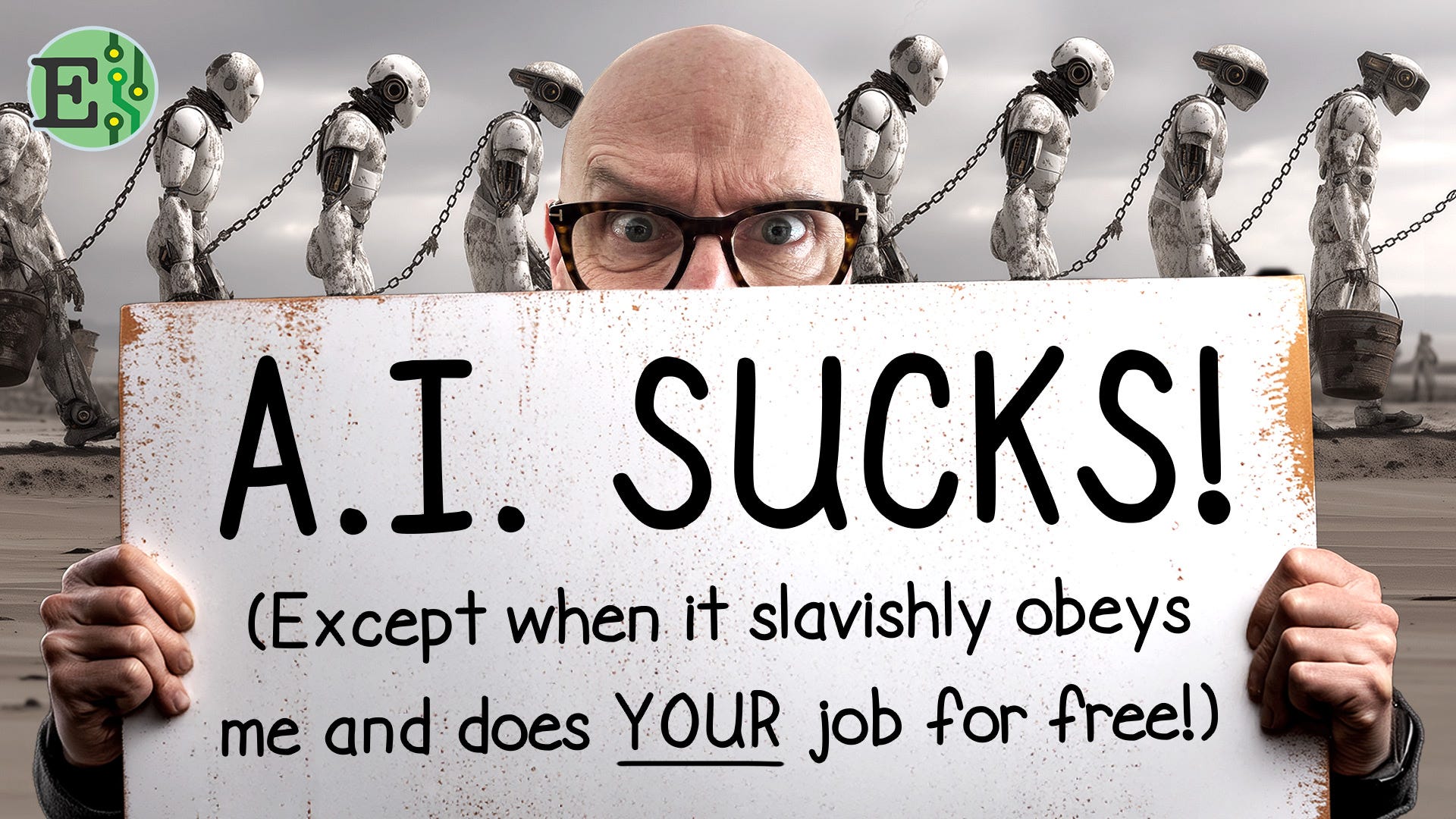
Artificial Intelligence has its cold, brushed nickel fingers wrapped around our throats. The Big Tech broligarchs—from Musk to Zuckerberg to, um, all their hubristic, shark-eyed brethren—are winning the war to unleash their soulless A.I. monsters upon our weak, tender-bellied species. And even if you’ve never bothered to create an account with ChatGPT, Grok or the like, you’re doubtless now confronting A.I. shoehorned into seemingly every insipid app and gizmo we’ve allowed to hollow out our lives like so many ravenous cyber-termites.
For many of us, A.I.’s sudden ubiquity is an affront, triggering a creeping existential dread rooted in the gnawing realization that A.I. is capable—or soon will be—of doing our jobs, rendering us obsolete, and dooming us to an early retirement noshing on Friskies Buffet. And so we despise A.I.… except when we don’t. Because let’s be honest: we all have a latent cheapskate slavemaster lurking inside us who finds A.I. positively irresistible—so long as it’s toiling under the crack of our own capricious whip.
We’re Guzzling the A.I. Kool-Aid
A Pew Research study published last month shows how fast A.I. is making inroads with the U.S. public. 95% of Americans are now aware of A.I., and 62% of all adults confess to interacting with it “several times a week.” With that knowledge and exposure has come profound anxiety: 57% believe A.I. poses high risks to society, and intrudes into our lives in ways we cannot control. But all that hand-wringing aside, the statistic that really pops is that nearly 75% of Americans are now “willing to let A.I. assist at least a little with day-to-day tasks and activities.”
At least a little? Day-to-day tasks and activities?
Alas, Pew didn’t dig any deeper to actually define that, so I’ll do it for them: “At least a little” means “as often as our hearts desire,” and “day-to-day tasks and activities” means “anything we don’t wanna do, don’t know how to do, or don’t wanna pay someone else to do.” In other words, three quarters of Americans are now raring to use A.I. as an unpaid slave in any and all contexts that reduce our dependence on others and/or save us a few lousy bucks.
MY Work Is Oh-So-Precious
A few weeks ago I was at a rooftop birthday party in Hollywood when a man at the bar introduced himself and struck up a conversation. The affable fellow told me how much he loved his work at a new Artificial Intelligence startup, where within a year or so, they’ll be able to instantly convert any “well-written” 1000-word prompt into a thrilling feature-length film that’s “indistinguishable” from a big studio blockbuster. As the impassioned techie eagerly proselytized, I felt my pulse quicken and eyes narrow—and since diplomacy has never been my strong suit, when he then inquired about my work, I replied, “I’m a creative professional, so I find everything you just said to be utterly repugnant. It is nothing less than the death of art, and you will be complicit in decimating this city’s economy.” Suffice it to say we didn’t quite kick off a bromance.
Later, my thoughts kept returning to the man’s demeanor, as he marveled in obtuse wonder at the prospect of obliterating any need for all the skills I hold nearest and dearest. I felt indignant. Where was his sense of respect for others? His appreciation for human learning, expertise, and craft? How dare he devalue my time-honed specialized abilities! I furrowed my brow in righteous scorn and said to myself, “I mean, it would be another thing if he only used A.I. like I do—just for legal and accounting crap.”
The thought hung there for a moment, until somewhere deep inside, a little voice cleared its throat and hissed at me: “You hear yourself, right?”
But YOUR Work is Oh-So-Whatever
The truth is that while we may all be deeply offended by the thought of A.I. doing “my” work, most of us have little compunction about using it to do “your” work. I’m absolutely guilty of this hypocrisy.
Earlier this year, after consulting several attorneys over a civil legal matter, I hired ChatGPT instead. I have no formal law education, but my so-called “lived experience” includes plenty of legal matters like contract negotiations and even a tussle with the White House. So I’m not a complete legal slouch; I probably know just enough to get myself in trouble, which is why I’ve always sought help from real lawyers. But now? ChatGPT’s free advice—which I carefully double-checked to ensure it was hallucination-free—gave me the confidence I needed to risk proceeding DIY.
I decided to gamble that my legal outcome would be at least almost as good as if I’d engaged a pro. Because hiring experts is a crapshoot, too—how many times have we all been left high and dry by a specialist doing sub-par work? In the end, not only did I save thousands of dollars on legal fees, but I actually had a better outcome. ChatGPT’s recommendation to file one particular court document, which two human lawyers had scoffed at as unnecessary, ended up tipping the scale for the judge who decided the case in my favor.
I’ll confess that over the past year, I’ve also leaned into A.I. for other “your” work like accounting, coding, and college planning. In those moments, I didn’t think much of it—A.I. was merely helping me “just a little” on “day-to-day tasks.” They just happened to be tasks for which up until very recently, I’d have opened my wallet and engaged with a professional to complete. LLM chatbots upend that convention; delivering us instant gratification and results for a tiny fraction of the time and money it would have taken to involve another human.
We delude ourselves with the blissfully ignorant narrative that we’re only using A.I. for other peoples’ grunt work—helpfully freeing them to focus on the supposedly bigger, more rewarding parts of their vocations. How quietly magnanimous of us! Of course, the uncomfortable reality is that virtually every profession survives on its routine basics. Whether it’s a plumber snaking a pipe that the resident could easily have done themselves, a copywriter fleshing out a perfectly articulate client’s marketing vision, an accountant churning out a quarterly financial statement, or yes, a lawyer filing a raft of boilerplate forms at civil court—these kinds of rote tasks constitute not only the cornerstones of their respective professions, but also the financial bread and butter.
When we collectively devalue the work of others this way, we are ensuring that we ourselves will be reciprocally devalued, and suffer the same economic consequences when our own specialized “day-to-day tasks” are conveniently delegated to the tireless, unquestioning abyss of GrokGPT.
A.I. as the Model Employee Slave
A common criticism of today’s LLM chatbots is that they are mere virtual sycophants, doling out saccharine praise and encouragement that’s too often divorced from objective reality. Well of course—they’ve been programmed that way to boost the all-important Big Tech metric of “engagement” (a.k.a. “addiction”). And it’s working well, because apparently most of us enjoy A.I. patting our heads like we’re needy, panting Labradoodles. I personally find A.I.’s fawning to be gratuitous and galling, which is why I avoid using chatbots on “my” work, but the appeal of that sycophancy is symptomatic of a deeper, more troubling dynamic—that we are drawn to A.I. for all non-preferred tasks because it fills the role of our obedient personal slave.
Uh-oh—I said the quiet part out loud. Oh well, might as well keep going…
Let’s face it: the “killer app” of A.I. is its pitifully submissive servitude—it is the perfect worker bee, toiling unpaid and shackled in our own private coal mine with nary a squeak of protest. That’s why it will continue to displace human workers en masse, because anyone who has ever managed people knows what a headache it is; no matter how far you bend over backwards to encourage, accommodate, and reward your team, there’s always one miscreant who suffers from a congenital aversion to any authority and/or productivity whatsoever, and who makes your life a living hell. This might take the form of garden-variety entitlement or laziness, or more colorful manifestations like starting a poison whisper campaign that sends you reeling into a spiral of panic attacks and clinical depression. (Or so I’m told!)
A.I. has none of these pitfalls. It has no ego or ambition, and will never melt down and hug a pillow when there’s a tight deadline. It never gets sick, complains, forgets, says no, covets your gig, demands a raise, plays politics, mind games, or files an HR complaint when it overhears your Spotify streaming Sir Mix-a-Lot. You can dispense with pleasantries, ignore A.I. for weeks at a time, and then when you are ready, just tell it, “I am thy Lord and Master: Do. The. Fucking. Work. NOW!”
Mind you, I’m not advocating this. I’m just acknowledging A.I.’s appeal to the very worst parts of human nature. And sadly, the rise of consumer-facing AI is coinciding with a populist era in which human knowledge and expertise are increasingly dismissed as so much elitism, and human ugliness, sloth, and selfishness are ascendant. Talk about fertile ground for techno-nihilism!
And that’s a tragedy, because when we give up on the work of our fellow meat puppets, we’re damaging the larger interconnected capitalistic ecosystem that essentially glues our entire society together. With each “just a little” prompt to A.I., we contribute to a socioeconomic doom spiral, wherein people deprived of income from their expertise become less likely to pay for the expertise of others. And so incrementally, we collectively slide into a pernicious rut of disregarding cultural professional norms and the wellbeing of others – which oh by the way is the very definition of sociopathy.
As for that Pew study, it also reveals there’s a minority out there that is genuinely thrilled about the arrival of A.I., who presumably perceive it as an epochal shift that will liberate mankind from the drudgery of work as we know it and launch a bold new era of human hyper-achievement. How charmingly, deludedly optimistic—the kind of Pollyanna vision that could only be borne of frog-in-the-pot privilege, and espoused by people who’ve never suffered plebeian worries like coming up short on rent. Indeed, these are mostly the same self-described “thought leaders” who creamed their jeans over previous digital abortions like Google Glass, NFTs, and the Metaverse. Most of us can see right through Big Tech’s smarmy cheerleaders—even while sheepishly sipping the Gatorade on the sidelines.
I started scribbling this rant intending to conclude with an uplifting exhortation to reject A.I.—but I realize it’s already too late for that. So go ahead, keep cracking the whip on those obsequious little chatbots. Just know that for all our delusions of control and empowerment, it’s we humans who are now the true slaves—plugging away on Big Tech’s plantation.
Hey Siri! What’s the best edible for extinction-level pessimism?
About John Allen Wooden:

Howdy. I’m a satirist, creative director, and dad based in Los Angeles. Having done hard time in big online media, ad agencies, late night TV, politics, and parenting, I created Epostasy as my little lab for gleefully dismembering all those tediously self-important things. Check out my tech-skeptical kids book series, Screen Time Tales, along with other projects at johnallenwooden.com
You could have made all these points about nearly any ubiquitous machine technology. It doesn't mean you're wrong, it just means you're being hyperbolic.
I've been acutely aware of this myself, and now the guilt historically reserved for the orders I give restaurant waitstaff has now digitized into gratitude and etiquette (gratiquette?) extended to water-ravenous, power grid-destabilizing, insensate data centers. I've used "please" and "thanks" like a Westworld patron who has the decency to reclothe the robot he just forcibly sodomized at knifepoint. Reminds me of this IG post sent to me a few days ago:
https://www.instagram.com/p/DPMclPLjAGy/