


PART 5
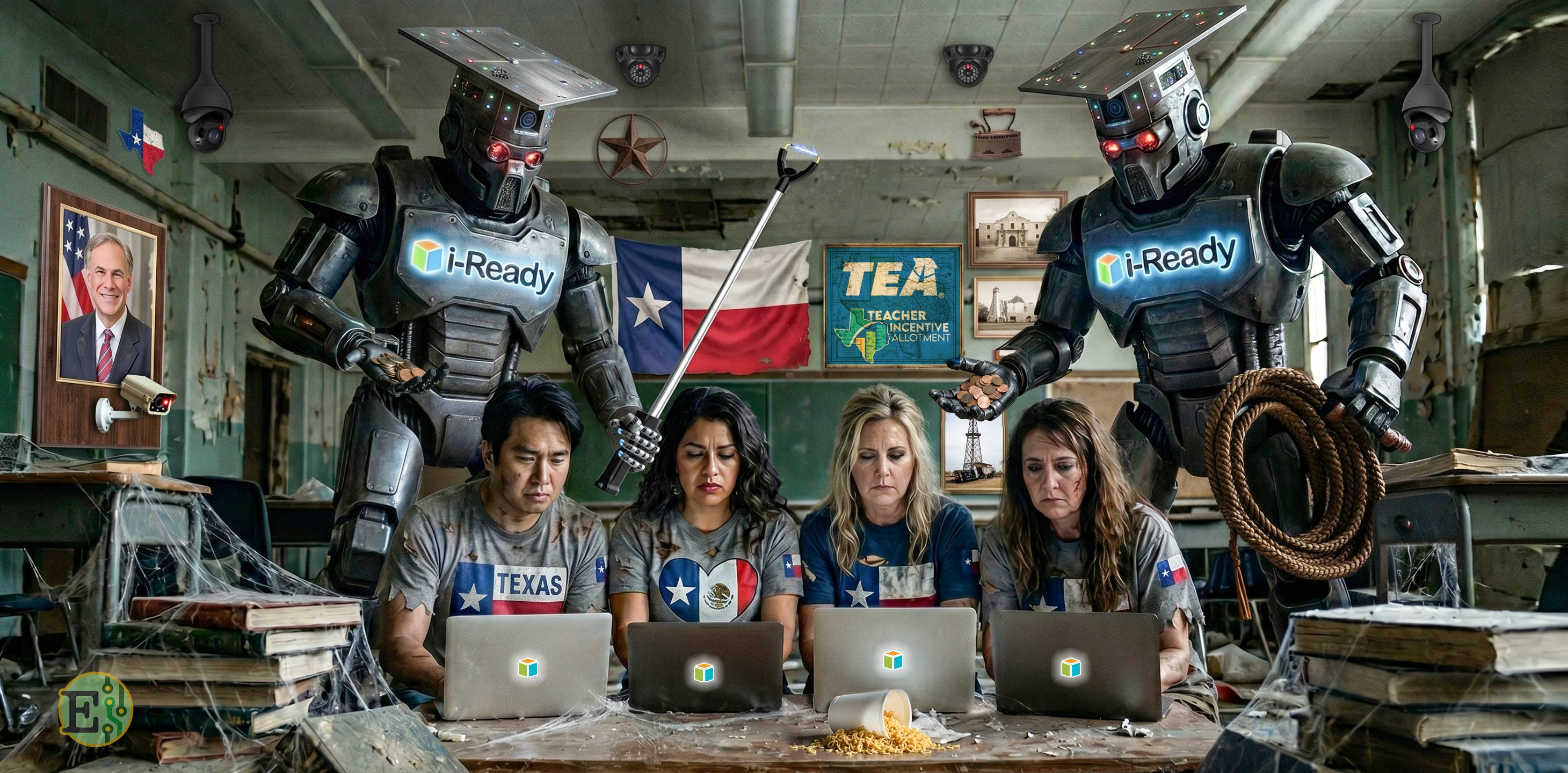
At the Fall 2025 “Impact in Action Summit” for i-Ready, the experimental e-learning software that is the bane of 14 million American children’s existence, a numbing panel discussion was unfolding atop a drab, fluorescent-lit dais. As a glad-handing moderator from i-Ready’s publisher Curriculum Associates (CA) lobbed softball marketing questions to administrators from Houston’s Alief Independent School District, a YouTube video captured the moment when district functionary Katrina Harris boasted cheerily, “i-Ready is tied to our teachers’ TIA!”
TIA is the Teacher Incentive Allotment, a uniquely Texas merit pay system for granting five-year bonus packages of up to $180,000 to public school teachers. At the very mention of it, Harris’ co-panelist colleagues grimaced uncomfortably as the room filled with audible murmuring from the off-camera audience of educators. This low drone persisted as the bureaucrat continued, “this adds another layer of competition or motivation on our teachers!”
Why was the audience murmuring? Because Harris’ revelation that i-Ready is “tied” to TIA means just one thing: any Alief ISD teacher failing to compete, by rigorously drillmastering students as young as kindergarten to ace their screen-based i-Ready assessments, can suffer severe personal financial consequences.
In practice, this means that Curriculum Associates’ proprietary, black-box platform now functions as a shadow evaluation arbiter for public servants: creating a perverse financial incentive for teachers to push i-Ready usage, regardless of whether the program supports real learning, or even harms student cognitive development by virtue of requiring countless hours of screen time.
Dr. Sarah Woulfin, Chair of the Department of Education Leadership & Policy at University of Texas at Austin, expressed concern at this usage of i-Ready. “It is not meant to be used as an assessment of the teacher’s teaching,” she told me of i-Ready by phone. “If TIA funding is attached to it, that’s high stakes for the individual teacher,” she noted. “It adds stakes and teeth to i-Ready in a way that I feel is inappropriate. A teacher could end up losing their job.”
TIA: Teachers Inquisition Accounting
The TIA program was created in 2019 as part of an $11.6 billion state school reform package which passed the Texas Legislature with unanimous bipartisan support. Its mission is to provide Texas teachers, whose compensation lags $8500 below national averages according to the Texas State Teachers Association, with “an accessible pathway to a six-figure salary.” But the program is no wokey pork barrel handout; it awards bonuses only to teachers who pass hard-nosed corporate-style reviews: using micromanaging classroom inspections to ensure compliance with its many onerous mandates, coupled with “student growth” accounting based on standardized test scores. If any teacher’s classes come up too short on their testing averages — bye-bye, big bonus.
Curriculum Associates’ proprietary, black-box system now functions as a shadow evaluation arbiter for public servants: creating a perverse financial incentive for teachers to prioritize i-Ready metrics, regardless of whether the program supports real learning, or even harms student cognitive development.
Cynthia Ramirez, a recently retired history and English teacher who taught grades 6-12 across tenures at three different Texas school districts, penned an op-ed last year describing TIA as primarily an “incentive to obey.” She told me that she and her colleagues found the system “bewildering and humiliating.” Ramirez recalls that while most of her fellow faculty members went along to be compliant, privately teachers complained that TIA requirements were “unfair and random,” adding “a colleague told me she was so stressed, she felt she needed to take a medical leave.”
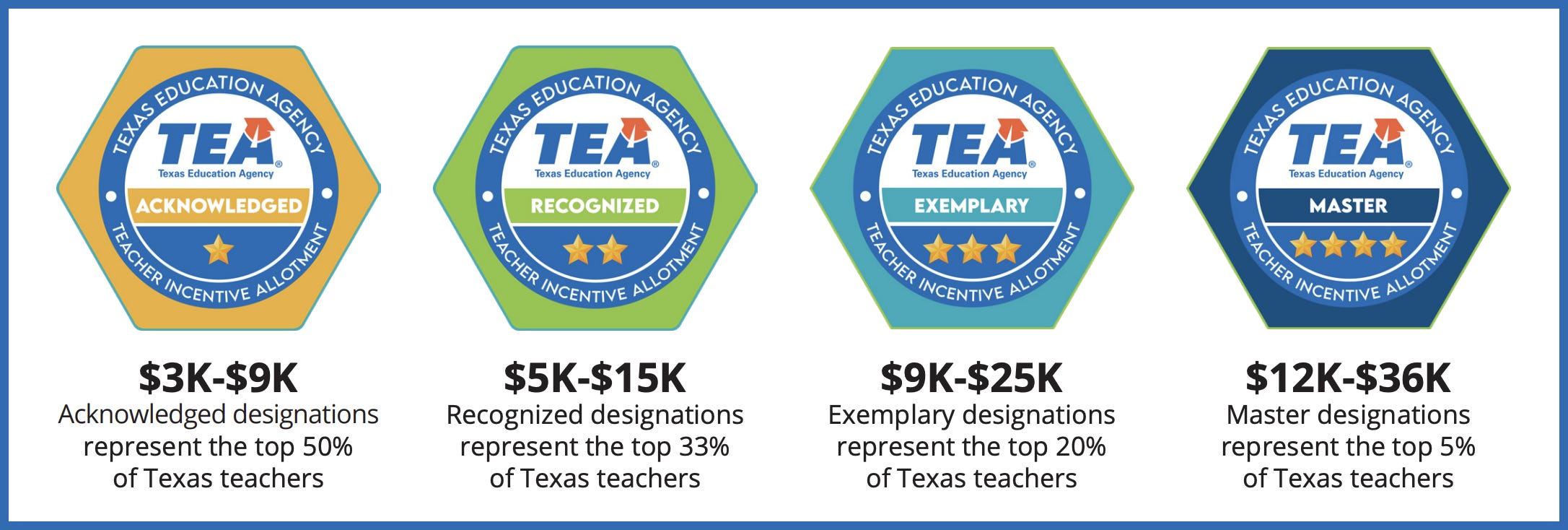
Norma De La Rosa, president of the El Paso Teachers Association (EPTA), also sees pronounced TIA anxiety among her members. She describes the program as “a monster” that is “pitting teachers against each other.” De La Rosa told me by phone, “a lot of my teachers are telling me, ‘You know, I don’t want the TIA money because it’s become so stressful,’” adding, “I have teachers getting out of education because all the focus is on this testing.”
As of 2026, 85% of Texas Independent School Districts participate in the opt-in TIA program, which annually disburses over $750 million in teacher bonuses across 1000+ districts enrolling 4.5 million students.
To be accepted into TIA, Texas school districts must devise formulas for scoring their teachers. These “designation” calculations vary, but all heavily factor “student growth” metrics, which must be measured using products from the state-produced Third-Party Assessment Options catalog. i-Ready has appeared in that catalog since its 2019 inception.
While Texas produces no centralized public list of which districts have i-Ready baked into their TIA designation calculus, an extensive review of publicly posted district handbooks reveals at least twelve that do, including Alief ISD, Dallas ISD, and El Paso ISD. Several of these districts rank in the top 1% of American public school systems by size, with all twelve collectively schooling over 380,000 K-12 students and employing over 26,000 full-time teachers.
Texas Districts Rating Teachers with i-Ready
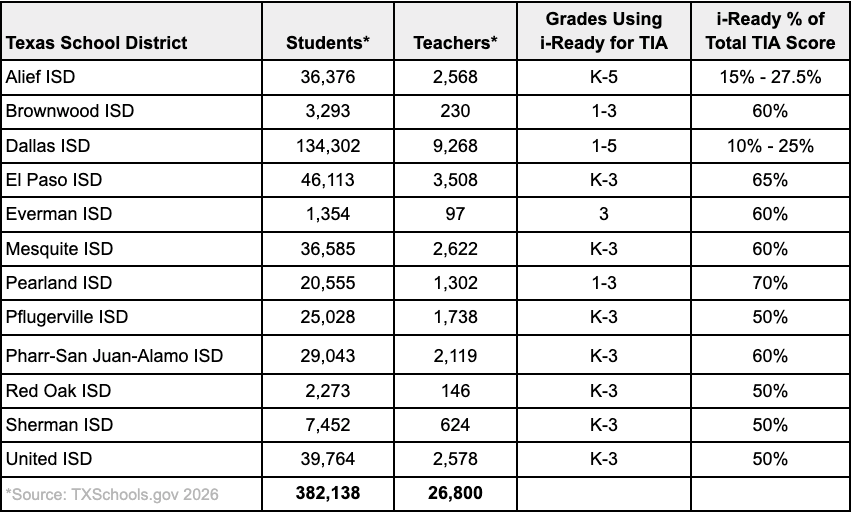
Official public documents and TIA Handbooks from these districts codify i-Ready scores accounting for significant portions of teachers’ overall bonus scores — as high as 65% and 70% at El Paso and Pearland ISDs, respectively. This, of course, is easily enough to make or break an already-underpaid educator’s annual five-figure TIA bonus.
Picture a hypothetical kindergarten teacher in El Paso ISD with and an above-average classroom observation score of 4.5 and 24 students. According to the district’s 2026-27 TIA manual, unless at least 50% of her class meets i-Ready’s self-defined “Typical Growth” targets, she is ineligible for any TIA bonus, which in her district ranges across tiers from around $5,600 to $21,000 a year for five years. This means that one illiterate five-year-old clicking the wrong button on i-Ready’s confusingly designed user interface can cost an otherwise top-performing teacher tens of thousands of dollars, all on a black-box test that can’t be independently audited.
Clay Robison, Public Affairs Specialist at the Texas State Teachers Association, expressed his organization’s concerns. “We do not like these standardized assessments being heavily used to evaluate teachers and determine how much extra they’re going to get paid,” he told me. “They’re given too much weight in determining how much student achievement has improved, and if the system itself is dubious, or unproven, or opaque, we have problems with that.”
Protesting that her fluent readers had been grouped with kids who didn’t even know the alphabet, Ms. S told a Curriculum Associates employee, “You’re asking me to make an intervention group based on incorrect data.” She recalls the i-Ready rep shrugging in response, and suggesting the false baseline could help create a positive data narrative later, stating, “Well, at least you could say that you’re going to get some growth — and that’s good.”
Harming Texas’ Youngest Students
In May 2026, the U.S. Surgeon General’s Warning on the Harms of Screen Use called on all American schools to “Limit screen use by assigning work in books or on paper whenever possible” — especially for young students.
Which makes for cruel irony that at the twelve Texas districts examined for this investigation, i-Ready TIA pressure is exerted overwhelmingly on teachers of K-3 students — the youngest and most vulnerable to screen time cognitive harm. That’s because student growth for older students can be measured using Texas’ annual STAAR standardized test, which assesses grades 3-12. But because the TIA program’s unflinchingly rigid bureaucracy demands teachers of every grade level be scored, i-Ready’s black box data is used to fill the gap.
I reached out to all twelve districts for comment on how they reconcile their continued use of i-Ready with this year’s US Surgeon General health advisory on the cognitive harm caused to children by screens. Only four responded, all with boilerplate statements.
Nina Lakhiani of Dallas ISD replied tersely, “You can view our screen time guidelines here.” Meghan Cone of Sherman ISD replied that the district is “currently reviewing technology use in the classroom with the goal of reducing unnecessary screen time,” adding that “tools and platforms will be evaluated” and “those findings will inform future decisions about their use.”
A Kinder Calamity
For Ms. S, a 25-year veteran kindergarten teacher at one of the largest districts using i-Ready for TIA scoring, and who requested anonymity for fear of what she described as widespread professional retaliation, i-Ready is a developmentally inappropriate classroom distraction. She told me her students were utterly flummoxed and frustrated by the platform. “These poor kids, they didn’t know how to use the program,” she said, “they’re looking at you like, ‘Do I just push this button, or this button?’ They’re not grasping the information, and they’re losing basic thinking skills because we’re just pushing ahead.” She insists that her students’ i-Ready scores don’t accurately reflect their knowledge. “All of our kids came out low because of the technology,” she recalled.
Because of that glaring disconnect, Ms. S balked when teachers at her school were mandated to create classroom cohorts based on i-Ready data. Protesting that her fluent readers had been grouped with kids who didn’t even know the alphabet, Ms. S recalls telling a Curriculum Associates employee, “You're asking me to make an intervention group based on incorrect data.” She said the i-Ready rep shrugged in response, suggesting the false baseline could help create a positive data narrative later, stating, “Well, at least you could say that you’re going to get some growth — and that’s good.”
Exacerbating the dysfunction, Ms. S said neither the faculty nor administration at her school were even trained on the platform. “The teachers didn't know the mechanics of how the test was working,” she said, “Like, when does the button light up? Do they have to pick one answer? Do they have to scroll?” Later, when she approached her principal to request guidance on picking realistic growth targets within i-Ready’s points system, the uninformed response was merely, “I don’t know, but each kid just needs to have a goal.”
As for student i-Ready results constituting over 50% of her TIA bonus score, Ms. S disapproves. “Am I stressed about the money?” she asked aloud. “The thing that puts pressure is when you see another teacher that maybe you don’t think is as great, and they get the money,” she sighed. “I think it’s 100% unfair that TIA is using an i-Ready program that I don’t even know about.”
A Circular Vetting Loophole
Alief ISD’s TIA handbook is typical among Texas districts in justifying its decision to score teachers using i-Ready, stating it has “chosen assessments that have been found by the State to be both valid and reliable.” But have they been?
i-Ready appears in the official online TIA Third-Party Assessment Options catalog — the homepage of which prominently indicates TEA conducts reviews of every product therein to ensure it “meets the requirements” of Texas law for student growth measures. But in a jaw-dropping instance of bureaucratic ineptitude double-speak, just two paragraphs later, a prominent disclaimer indicates that all product details are “vendor-provided and not verified… inclusion in this list does not imply TEA endorsement.”
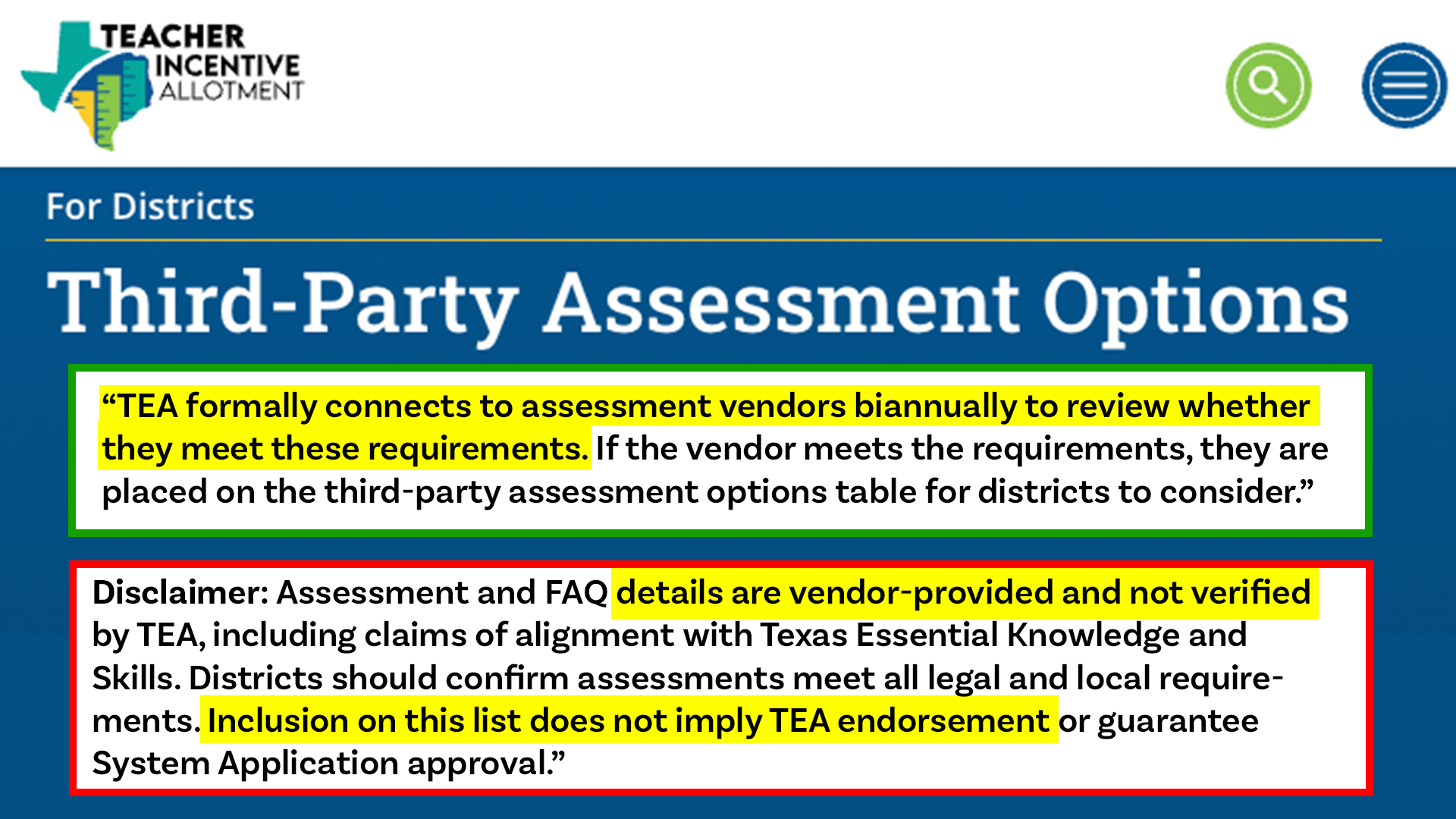
Indeed, inclusion in the state’s catalog is not based on any independent validation or formal state vetting; it’s granted following biannual vendor self-checks, which take the form of thin FAQ documents. Stunningly, despite being vendor-authored and “not verified,” these files are distributed to districts on official TEA government letterhead PDFs via the TIA website, thereby oxymoronically signaling their contents are state-endorsed.
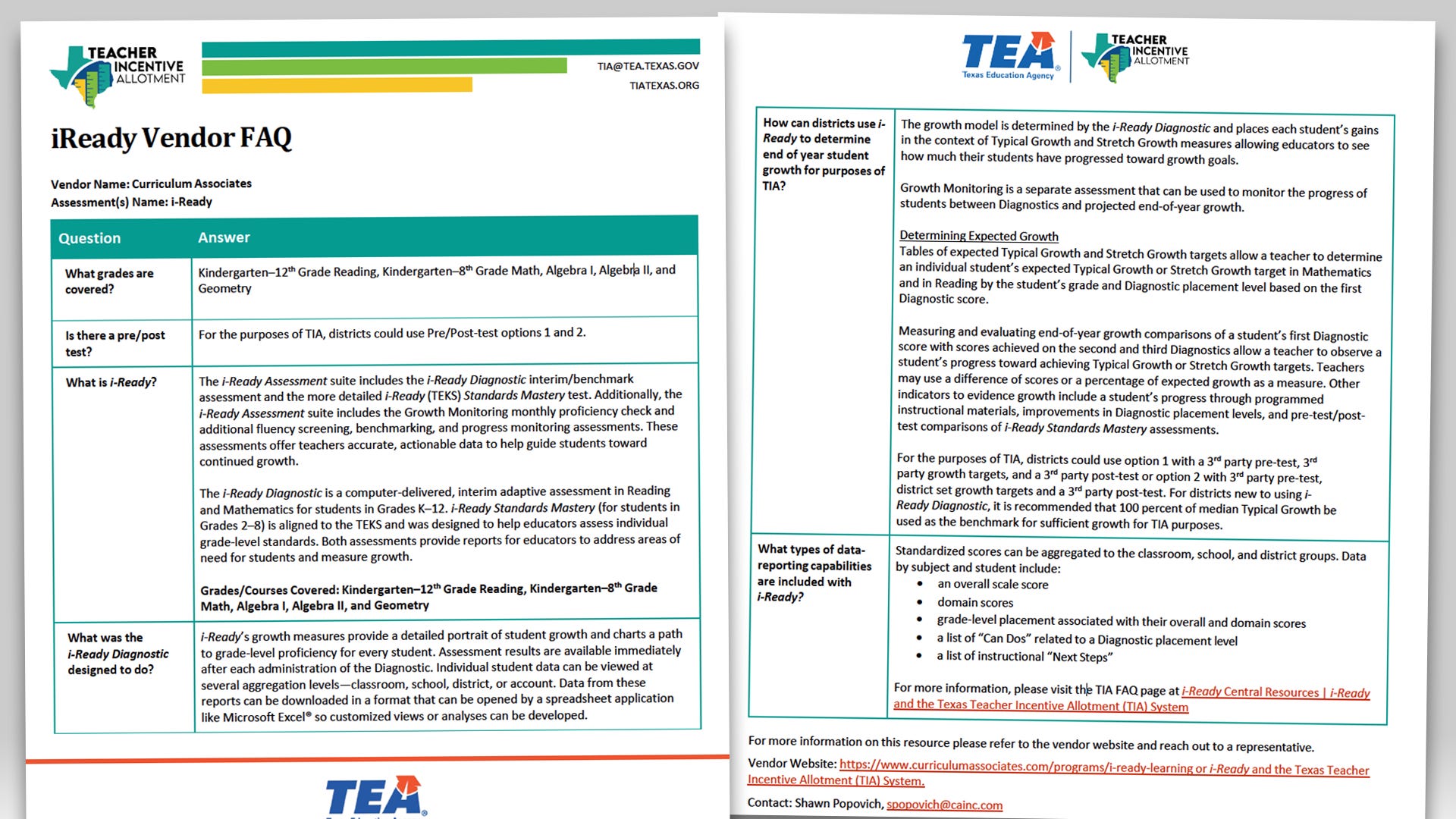
In further disclaiming, “Districts should confirm assessments meet all legal and local requirements,” Texas Education Agency foists its ed-tech vetting responsibility onto districts, whose TIA guidebooks often indicate their selections are based on the presumption that TEA has completed said vetting. In other words, Texas has created a kind of circular regulatory hot potato loop in which Curriculum Associates’ spurious claims of efficacy escape all necessary scrutiny, enabling i-Ready to be effectively self-approved into the TIA program.
Unsurprisingly, Curriculum Associates’ TIA FAQ instructs districts to measure student growth using its proprietary "Typical Growth" and “Stretch Growth” metrics. This is another deployment of CA’s notorious closed-loop evidence system, wherein it defines the baseline, sets the growth targets using proprietary algorithms, and writes, administers, and scores the tests. Everything under the i-Ready hood is a trade secret, meaning neither classroom teachers nor Texas state auditors can see test questions or verify how a student's target was calculated. It’s the ed-tech fox guarding the TIA henhouse — wearing a Texas Ranger uniform, no less.
Given that Curriculum Associates has also long been criticized by the likes of Johns Hopkins University and others for gilding its own lily with self-authored research, and is now facing a class action lawsuit alleging false advertising over those same science-washing marketing practices, this raises enormous red flags.
Texas has created a kind of circular regulatory hot potato loop in which Curriculum Associates’ spurious claims of efficacy escape all necessary scrutiny, enabling i-Ready to be effectively self-approved into the TIA program.
I reached out to Texas Education Agency multiple times to request comment on the vetting contradictions within their Third-Party Assessment Options Catalog, the propriety of distributing vendor-authored marketing documents on TEA stationery, the appropriateness of grading teachers using an unauditable proprietary black-box product, and whether they accept the US Surgeon General’s screen time advisory as valid. TEA Communications did not respond.
But Norma De La Rosa of the El Paso Teachers Association expressed certainty that this vital regulatory ball was indeed being dropped. “The way the districts are running right now is that they’ll see these programs coming through the TEA catalog, and they’re saying ‘we’re going to assume it’s a good program,’ without really vetting.”
Edu-Groupthink Blues
So how did i-Ready come to dictate K-3 teacher compensation in Texas? UT Austin’s Dr. Sarah Woulfin chalks this up to the herd mentality of educators, explaining, “Everyone in Texas knows that everybody’s using i-Ready, and so a lot of districts assume, ‘Dallas is using it, therefore it must be a good thing’ — but we actually don’t know the impact of i-Ready in Dallas or Alief.”
Woulfin notes that Curriculum Associates’ self-authored research also fills a void that’s been created by a dearth of legitimate research. “The education research community should take a little bit of blame that we have not spent more time and energy to try to study how districts and schools are taking up these ed-tech platforms.”
But Woulfin also laments that it’s increasingly difficult to conduct such research in Texas. “It’s hard to get access to schools and districts and it’s only gotten harder,” she said. “They don’t want too many eyes on what’s happening with products like [i-Ready].” She believes education administrators fear what transparency might reveal. “If I said I wanted to study how is i-Ready doing in kindergarten, I think folks would be like, ‘we’re not sure we want to show you how our kindergarteners are crying during i-Ready assessments.’”
A Nationwide i-Ready Pressure Cooker
It’s said that “as goes Texas, so goes the country.” And in many ways, Texas succumbing to Curriculum Associates’ data-based marketing narrative is not unusual. In the Lone Star State, as across America, the pressure exerted on educators to deliver higher i-Ready scores is often so intense, schools launch fever-pitch incentive campaigns. Parents are bombarded with flyers and invitations to special morning coffees and evening trainings, where school staff and Curriculum Associates employees jointly implore moms and dads to jack the kiddies into the i-Ready matrix for more screen time hours at home, too.
Worse, as explored in this series’ supercut videos, desperate educators resort to cringe-inducing “i-Ready Challenges” to stimulate student usage: offering bribes of sugar, cash prizes, video games, and humiliating acts of self-debasement like pies in the face — all because the stakes attached to i-Ready student usage rates can be career-derailing. This, of course, is classic panicked herd behavior borne of financial intimidation and professional existential dread.
Other states have also begun using i-Ready as a high-stakes lever. In California, Michigan, New York, and Florida—i-Ready usage is loosely woven into teacher evaluations, placement and promotion decisions, contract renewals, and the overall picture of teacher effectiveness. For now however, Texas still appears unique in cranking this pressure to eleven by explicitly tying i-Ready results into calculations for teacher bonuses.
I reached out to Curriculum Associates’ press office multiple times via email to request comment on whether the company condones the practice of tying i-Ready usage and data directly to Texas teacher compensation, and inquire what role (if any) the company plays in districts adopting such policies. Curriculum Associates did not respond.
But why would they? Because in retrospect, those were silly questions for me to ask. After all, i-Ready didn’t appear in the official TIA Third-Party Assessments Option catalog by divine intervention. Curriculum Associates applied to be included therein at the program’s inception, explicitly opting in its flagship product to become a high-stakes arbiter of teacher compensation. And Curriculum Associates has conscientiously renewed its TIA program participation for the past seven years, repeatedly updating those self-authored i-Ready Vendor FAQs that get distributed on TEA letterhead, in which CA deliberately markets and tailors its student growth models to satisfy state merit-pay criteria.
How i-Ready Messes With Texas
As America’s second-most populous state, Texas is clearly a major business priority for Massachusetts-based Curriculum Associates. While the company does not publish public rosters of its client school districts, its market penetration in the Lone Star State is significant. CA produces a custom Texas-focused variant of i-Ready, and in a 2025 self-authored report, indicated that i-Ready is actively used in at least 149 Texas school districts.
Last month, Curriculum Associates also held its secretive annual “Ferguson Institute” event in Texas for the second time since 2024. This strictly private, invitation-only gathering exists to bring “district leaders together to share ideas and connect.” Photos posted to social media by Curriculum Associates and guests from Dallas ISD show CA’s C-Suite brass in attendance: CEO Kelly Sia, CIO Ty Holmes, and controversial ed-guru John Hattie, presenting on “Skills when using AI.”


While all details about Curriculum Associates’ Ferguson Institute are carefully guarded — including attendees and event content — public board meeting documents from one Arizona school district reveal the event to be a classic Ed-Swamp™ affair, with CA footing the bill for all district officials’ travel, registration, meals, and lodging at Austin’s tony Hyatt Regency conference resort.
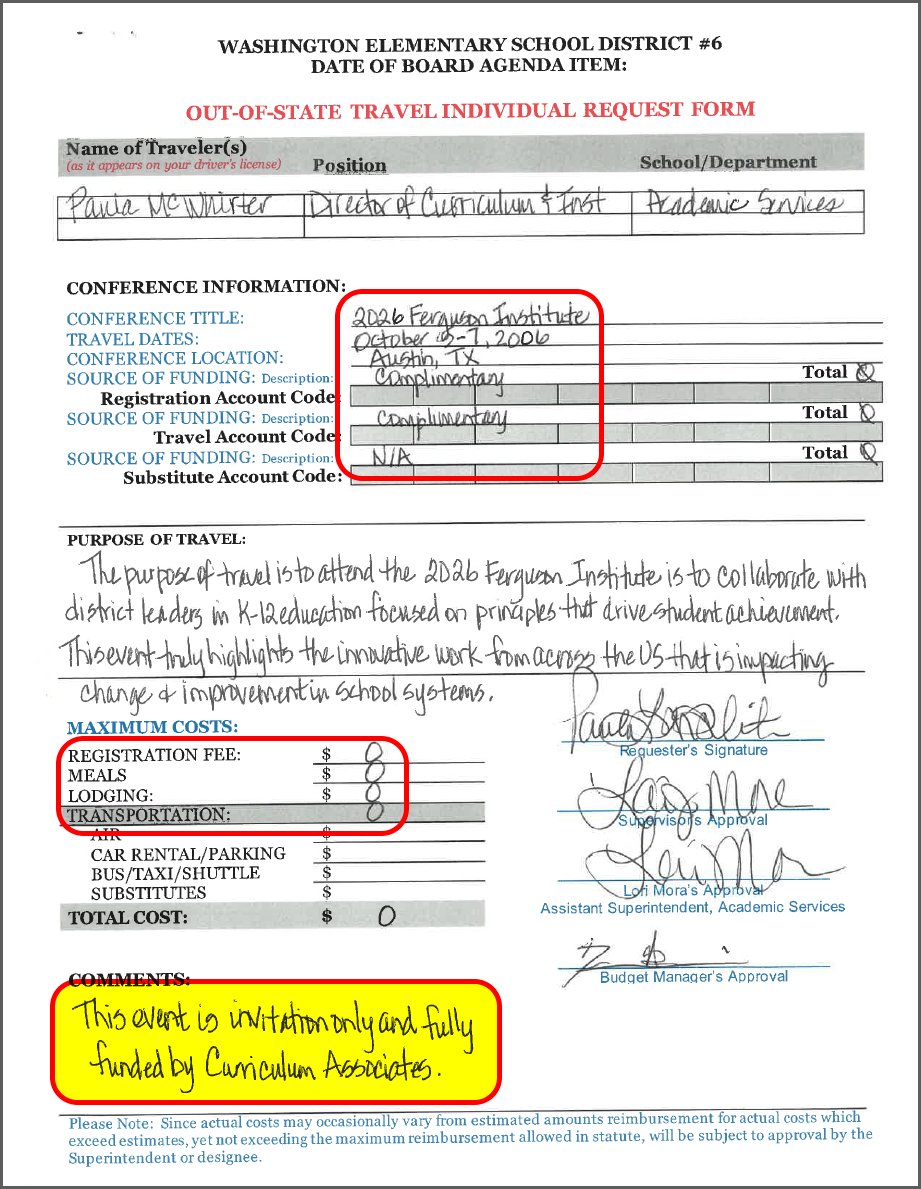
In other words, like Curriculum Associates’ “Extraordinary Educators” program, the “Ferguson Institute” is nothing more than another ethically dubious luxury junket for public school district employees, bought and paid for by a private equity-backed ed-tech vendor with a documented penchant for mendacity and an ice-cold indifference to the cognitive health of children.
It’s at Ed-Swamp™ events like The Ferguson Institute, where Curriculum Associates wines and dines district officials, that the big i-Ready deals are brokered, and tens of thousands of helpless teachers’ fates are sealed.
All Data, No Cattle
And so in Texas, i-Ready remains entrenched, effectively self-approved into the TIA program despite lacking any verification or legitimate proof of effectiveness. Most egregiously, it is deployed aggressively against K-3 students, who are most likely to suffer harm from its hours of screen-based tedium. This at the hands of their very own teachers, pressured to crack the whip on the very littlest ones under their care — all to deliver results that primarily benefit Curriculum Associates’ bottom line.
As for 25-year kindergarten teacher Ms. S, she’s equal parts fatalistic and resigned. “I think TIA was supposed to motivate teachers, but people at this point are like, ‘if I get it, I get it, if I don’t, I don’t,’” she said. “God knows I could use the money,” she said, “but I feel bad when it’s messing up all these kids.”
###
Read the Full Series:
i-Ready i-Reckoning: Unmasking Curriculum Associates' Ed-Tech Scam

The definitive critical exposé of Curriculum Associates — the shadowy firm that made e-learning platform i-Ready into mandatory misery for 14 million K-8 American students. Covering the i-Ready controversy: the teachers complaining it’s a boring waste of time that’s bad for …
FOLLOW THE PODCAST
Apple | iHeart | Podchaser | Spotify | YouTube
About John Allen Wooden:

Howdy. I’m a tech-traitorous writer, satirist, creative director, and dad of an i-Ready victim based in Los Angeles. Having done hard time in big online media, late night TV, ad agencies, politics, and parenting, I created Epostasy as my little lab for gleefully dismembering all those self-important things. Check out my tech-skeptical kids book series, Screen Time Tales, along with other projects at johnallenwooden.com
