


PART 4
Curriculum Associates (CA), the previously low-profile, billion-dollar ed-tech behemoth, is having a no-good, terrible 2026 — and it’s poised to get a whole lot worse. CA’s ubiquitous online learning platform i-Ready®, which is compulsory for 14 million American kids, is facing a remarkable wellspring of loathing from parents, students, and teachers across the country. But Curriculum Associates’ problems run much, much deeper than mere consumer subjectivity; they now face an outright existential threat borne of the inescapable reality that their flagship product is harmful to the health of the same human children it purports to educate.
By now, even mentioning the ever-growing mountain of scientific evidence linking screens with physiological harm to kids seems about as edifying as a reminder that the sun will rise tomorrow. Americans have grown so numb to revelations of childhood maladies caused by screens — from depression to anxiety to profound cognitive deficits — we’d likely just shrug at news they give kids rickets and hammer toe, too.
And yet, any ethical business, upon learning its product had been definitively linked to even one serious health threat, would promptly issue a consumer warning or recall. Curriculum Associates, on the other hand, now reveals its private-equity true colors — prioritizing the protection of its primary revenue stream over the health of children. Throughout the spring of 2026, CA has unfurled a cynical public relations campaign that mixes deceptive word salad and outright lies about its own history to portray i-Ready screen time as non-harmful and “limited.”
A Sly Public Health Nuisance
While the issue of screen time harm may have exploded into the popular consciousness only recently, it is hardly a new concern. Fully a decade ago, Dr. Nicholas Kardaras was among the first to sound the alarm with his best-selling book Glow Kids, in which the neuropsychologist presciently connected the dots between screens, dopamine addiction, and disastrous child mental health and cognitive development outcomes.
Doubtlessly aware of Glow Kids or the slow, steady drumbeat of warnings that followed, Curriculum Associates — as a savvy, liability-averse corporation keen to preserve plausible deniability — has long strenuously avoided any explicit public defenses of i-Ready’s screen-based format. Since the product’s launch in 2012, all educator or parental concerns about screen time were met with politician-worthy pivots to ed-tech blather. CA would stress “high-fidelity implementation” — pointing to outlier studies drawing distinctions between “passive” screen time and “active engagement.” In fact, Archive.org historical searches of curriculumassociates.com establish that the term “screen time” never once appeared on the website until 2026.
The i-Ready Screen Time Spin Begins
While i-Ready’s overall experiential and pedagogical lousiness have long sparked online vitriol from the students and teachers forced to use it, 2026 has seen the fury spread to a vastly larger community: families. After Part One of this series was published by UnHerd in late February 2026, Curriculum Associates was besieged by parental and teacher anger across social media. On X.com, the firehose of pent-up bile directed at i-Ready was so intense, Curriculum Associates effectively surrendered, publishing its last original post on that platform on March 10th.
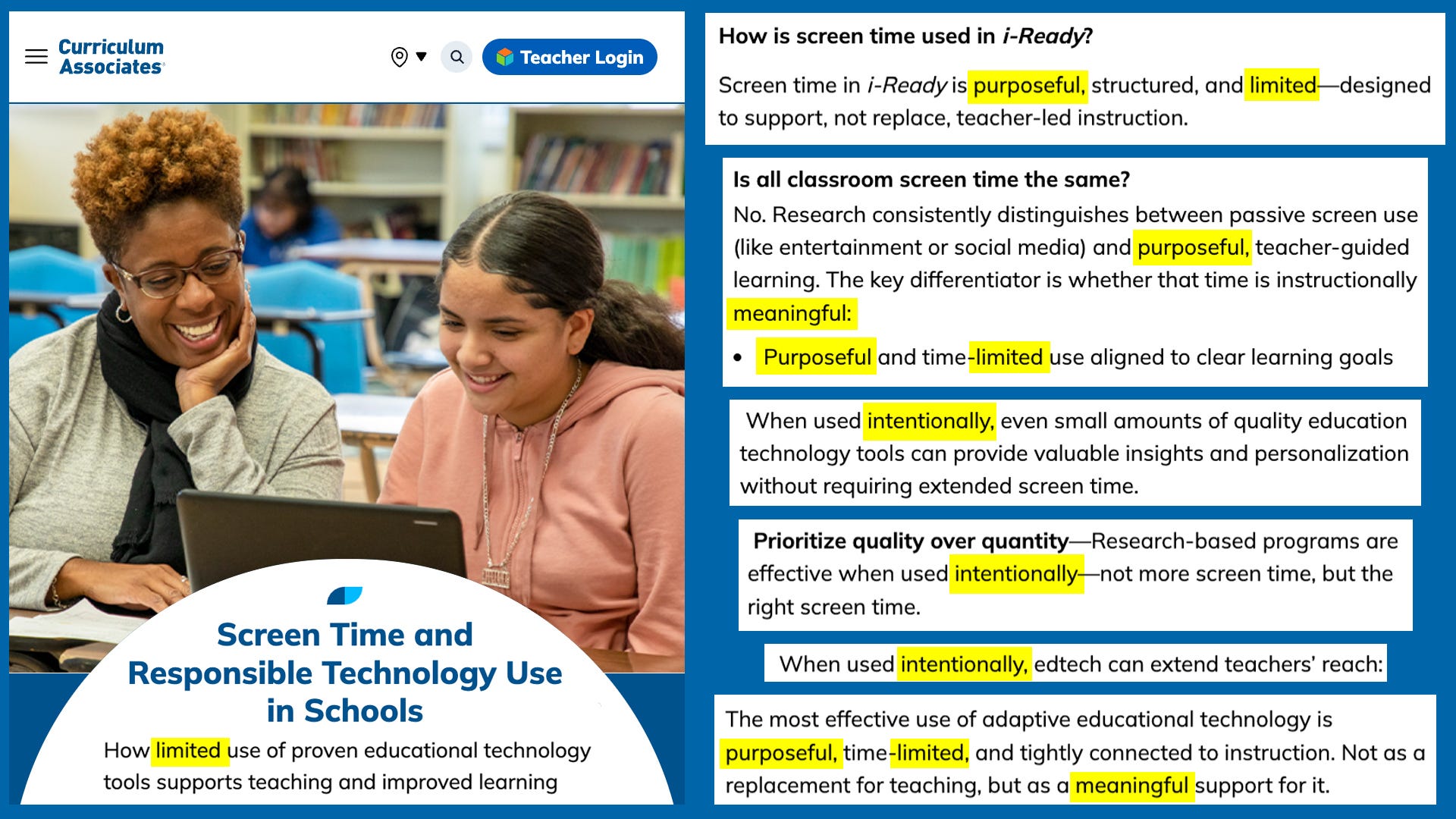
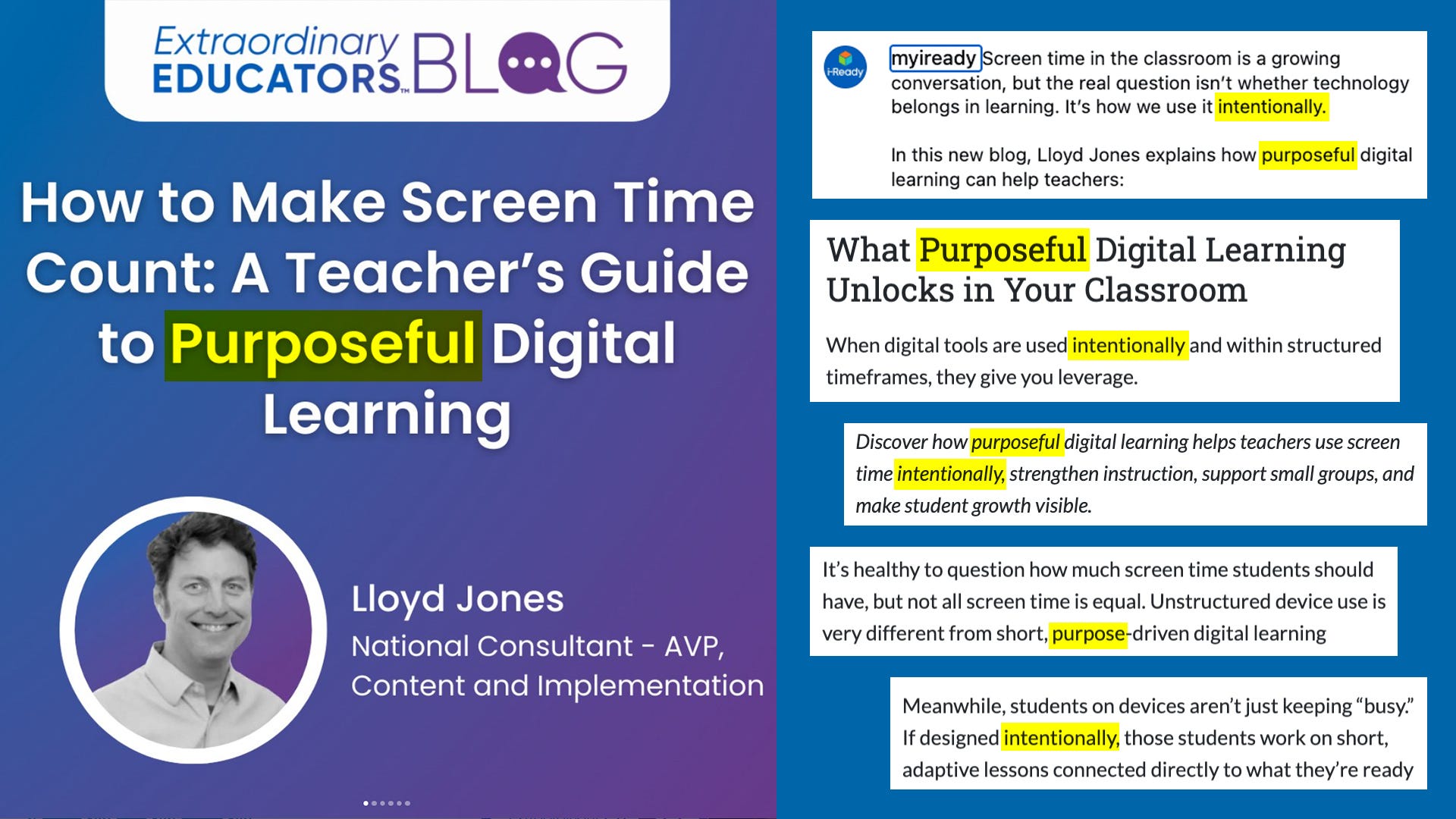
Two days later, Curriculum Associates commenced a rapid-fire defensive volley of PR damage control content to stanch the bleeding — all packed with a freshly-minted product vocabulary to whitewash i-Ready screen time as “limited,” “purposeful,” “intentional,” and “meaningful.” An all-new screen time section materialized on its website, featuring top executives contributing a succession of ponderously disingenuous essays. The new framing even makes a conspicuous cameo towards the end of a new testimonial from an i-Ready “Extraordinary Educator” — the fake awards program CA created to launder corporate marketing through real teachers.
On X.com, the firehose of pent-up bile directed at i-Ready was so intense, Curriculum Associates effectively surrendered, publishing its final post on that platform on March 10th.
“They’re in crisis mode,” said Drew Kerr, a prominent Communications Consultant in New York City who maintains The Red List, a compendium of corporate publicity crises. “When you see this kind of shift, obviously they are course-correcting,” he said. “They realize that every single word they say is now being hyper-scrutinized… They’re trying to tiptoe very, very carefully.”
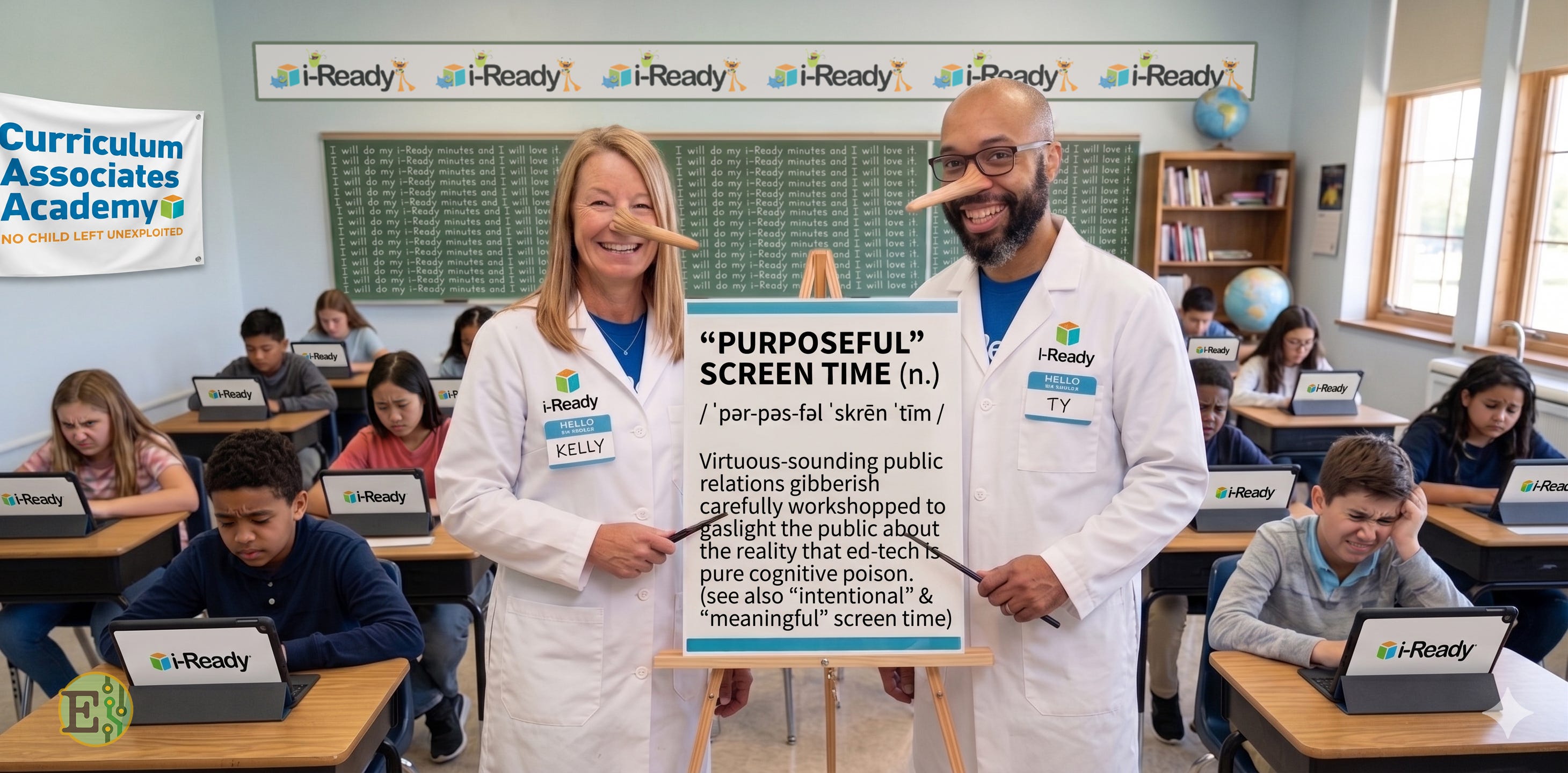
Kelly Sia, Chief Evasiveness Officer
For typical billion-dollar corporations, the CEO would serve as the face of this type of urgent crisis response. Unfortunately for Curriculum Associates, Kelly Sia, who ascended to the CEO role via internal promotion in 2025, demonstrates a near-total aversion or inability to represent the company publicly.
To date, Ms. Sia’s entire professional history of recorded public interviews appears limited to vacuous chit-chats on two podcasts — one hosted by her corporate underling, and the other by her private Executive Coach. (When Sia and I were booked opposite one another for NBC News TV interviews last month, she cancelled at the last minute.) Sia’s contribution to the i-Ready damage control effort so far appears limited to two April 2026 LinkedIn posts, wherein she floated the new “purposeful” semantic reframing, and was lavished with praise by sycophantic employee commenters.
Drew Kerr notes that kind of executive evasion is rarely effective. “There’s a theory that you can put your head in the sand, like an ostrich, and hope it will go away,” he said. “It’s a very dumb PR strategy.” Of Sia’s conspicuous invisibility during a corporate publicity crisis, Kerr added, “If a CEO has been off the radar for this long, it means either they are not taking it seriously, or the board does not trust them, and there’s questions about their status, or their ability to speak.”
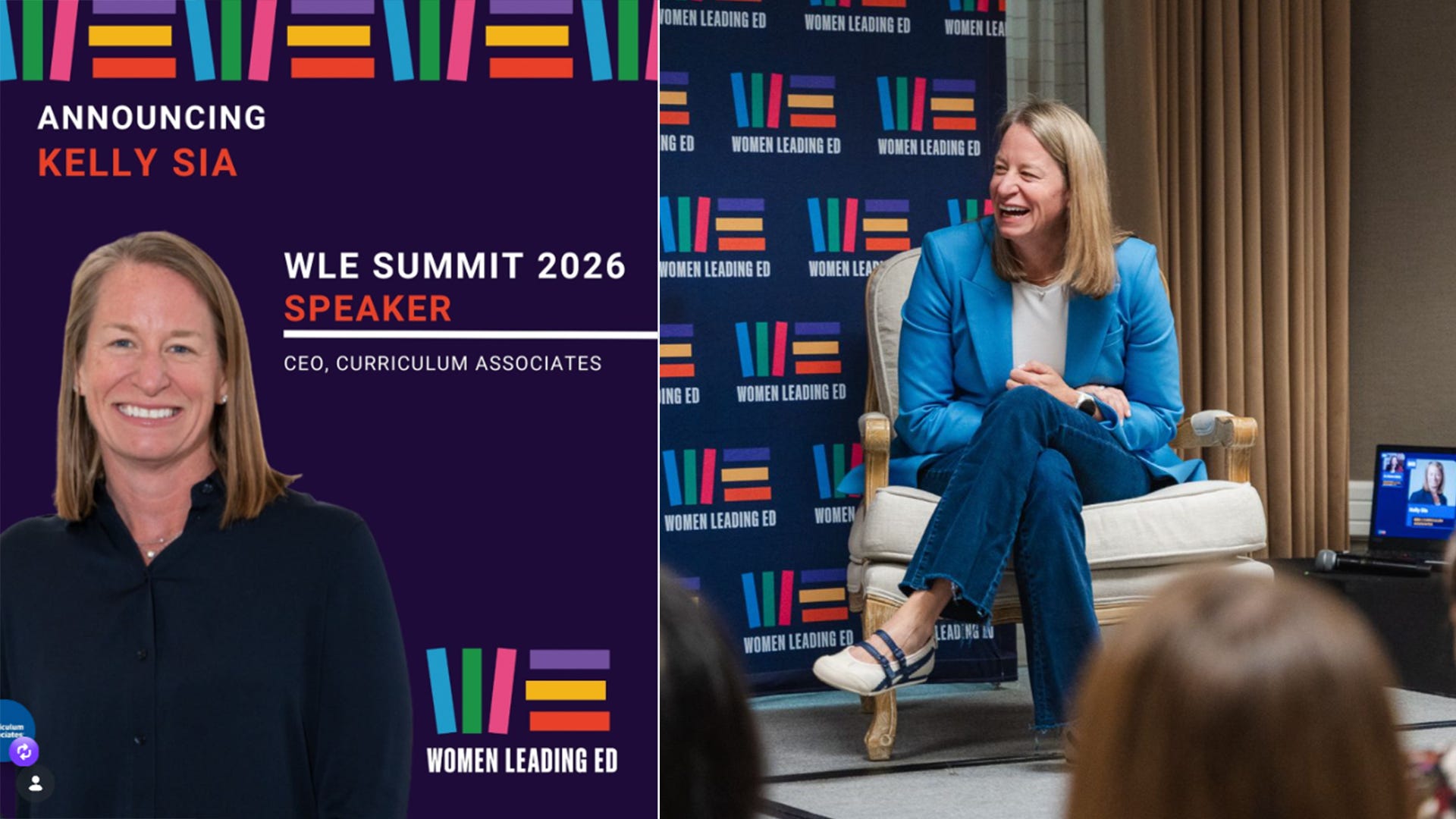
Sia’s only public speaking appearance of 2026 thus far was a closed-door breakout session about “leadership” at the Women Leading Ed Summit in North Carolina. Curriculum Associates was the title sponsor of that three-day event, and no recordings or transcripts of Sia’s remarks were released.
I emailed CA repeatedly to request comment on whether the company’s corporate board, Chairman Rob Waldron, and private equity backers Berkshire Partners and Permira remain confident in Ms. Sia’s ability to serve as CEO. Curriculum Associates did not respond.
Ty Holmes, Chief Indemnity Officer
In the ensuing leadership vacuum, it has fallen to subordinates, especially Tyrone Holmes — Curriculum Associates’ Chief Impact Officer and longtime head of internal anti-racism efforts — to carry Sia’s “purposeful” screen time water as the handsome public face of i-Ready damage control.
So far this spring, Holmes has taken Sia’s place in interviews for NBC News and education site Chalkbeat, a Global Silicon Valley panel, and dispensed “purposeful” screen time spin on an Edtech Insiders webinar.
Back at Curriculum Associates HQ, Ty Holmes also recently narrated a gauzy new video, “i-Ready in the Classroom: Purposeful Instruction for Every Student,” and penned a saccharine blog essay entitled “The Screen Time Question I Can’t Stop Asking as a Father and an EdTech Exec.” Writing of “watching my own children grow up in a world where screens are everywhere” Holmes repeatedly invokes “purposeful,” “intentional,” and “meaningful” to insist that i-Ready screen time can “get it right.” Throughout the missive’s 1000 words, he performs impressive linguistic somersaults to avoid mentioning whether his own children actually use i-Ready or other screen-based ed-tech. When I requested clarification and invited Holmes to speak with me via LinkedIn, he immediately blocked me.


Of course, some Big Tech executives famously admit to hypocritically curtailing their own kids’ exposure to the products they produce. I inquired via repeated emails whether the children of Mr. Holmes or any other C-suite executives have been compelled to use i-Ready as part of their regular schooling, and if so, whether they might be available to share their opinions of the platform publicly (as my son did). Curriculum Associates did not respond.
“Purposeful” Meaninglessness
For the past 14 years, CA’s core pitch to school district procurement officers has been that i-Ready is “data-based.” They promise the product can boost standardized test scores by analyzing millions of students’ intimate personal details — data so granular and voluminous, it can only realistically be harvested one way: via internet-connected screens. (The pitch is bolstered with reams of internally-authored “research and evidence” marketing collateral, and the paid endorsement of controversial pseudoscience ed-guru John Hattie.)
But suddenly, in the face of overwhelming science indicating that screen time is inherently harmful and essentially irredeemable, Curriculum Associates has frantically pivoted away from cold, clinical, data-centric verbiage — now promoting i-Ready screen time with those fuzzy, emotional, and profoundly unscientific tautologies: “purposeful,” “meaningful,” and “intentional.”
PR crisis management expert Drew Kerr has seen this playbook before. “When a company starts changing its language like that, it’s obvious that the lawyers are all over this,” he said. “But lawyers also know nothing about communications. It's like somebody showing up at the ball and not realizing that their tie is really ugly. They don't realize that the things they're saying are very obvious gobbledygook legalese.”
I reached out to CA repeatedly to inquire what metrics or peer-reviewed studies it uses to quantify whether i-Ready screen time is “purposeful” or “meaningful” — and whether their product road map includes plans to add any handy new color-coded dashboard charts to track students’ levels of “purposefulness” or “meaningfulness” within i-Ready. Curriculum Associates did not respond.
That’s unsurprising, because of course there is no science of purposefulness, metric of meaningfulness, or diagnostic of intentionality. Rather, this is textbook corporate reputation triage; invent a new brand lexicon to evade substantive dialogue about the fact that your business model and/or product has been revealed as literally toxic. Then you can (at least attempt to) steer the narrative, reframing your business and some diminished variant of your product as parts of a solution, rather than the original root cause. Think yummy fruity nicotine vape pens by RJ Reynolds or Philip Morris.
PR crisis management expert Drew Kerr has seen this playbook before. “When a company starts changing its language like that, it’s obvious that the lawyers are all over this,” he said... “They don’t realize that the things they’re saying are very obvious gobbledygook legalese.”
Sadly for Curriculum Associates’ nearly 3,000 employees, it’s a strategy borne of reluctant acceptance that your business has crossed the Rubicon; the gravy days are past and nothing will ever be as it was, but if you make enough concessions and talk a good game, your grievous corporate wounds might not be fatal. Sure, you can probably forget about profit sharing, dividends, and juicy year-end bonuses until perhaps-forever, but hopefully the base pay and cushy PPO health plan remain intact.
And so we see the empty new mantra of “purposeful,” “intentional,” and “meaningful” saturating i-Ready’s crisis response like a plaintive, desperate chant.
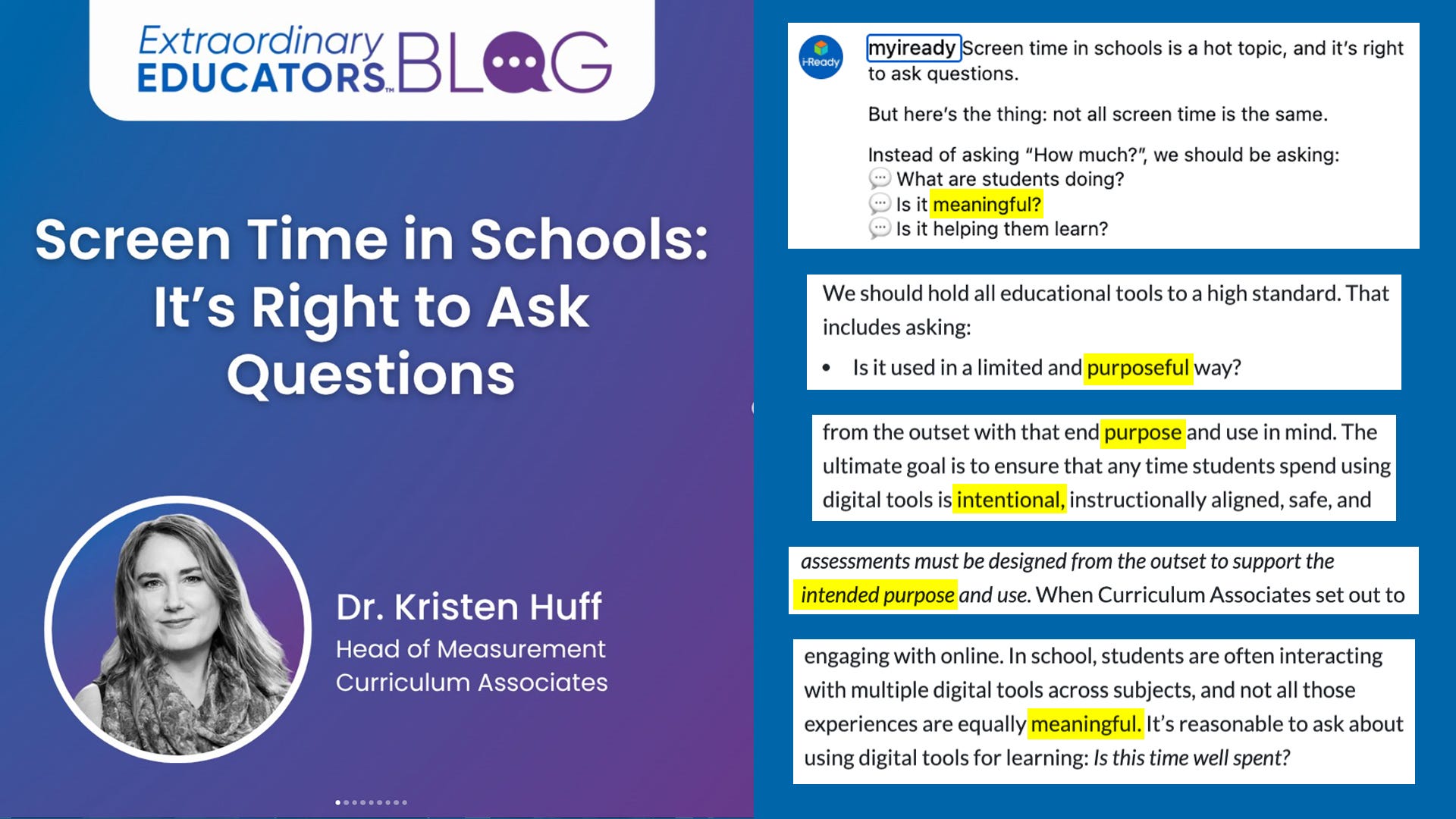
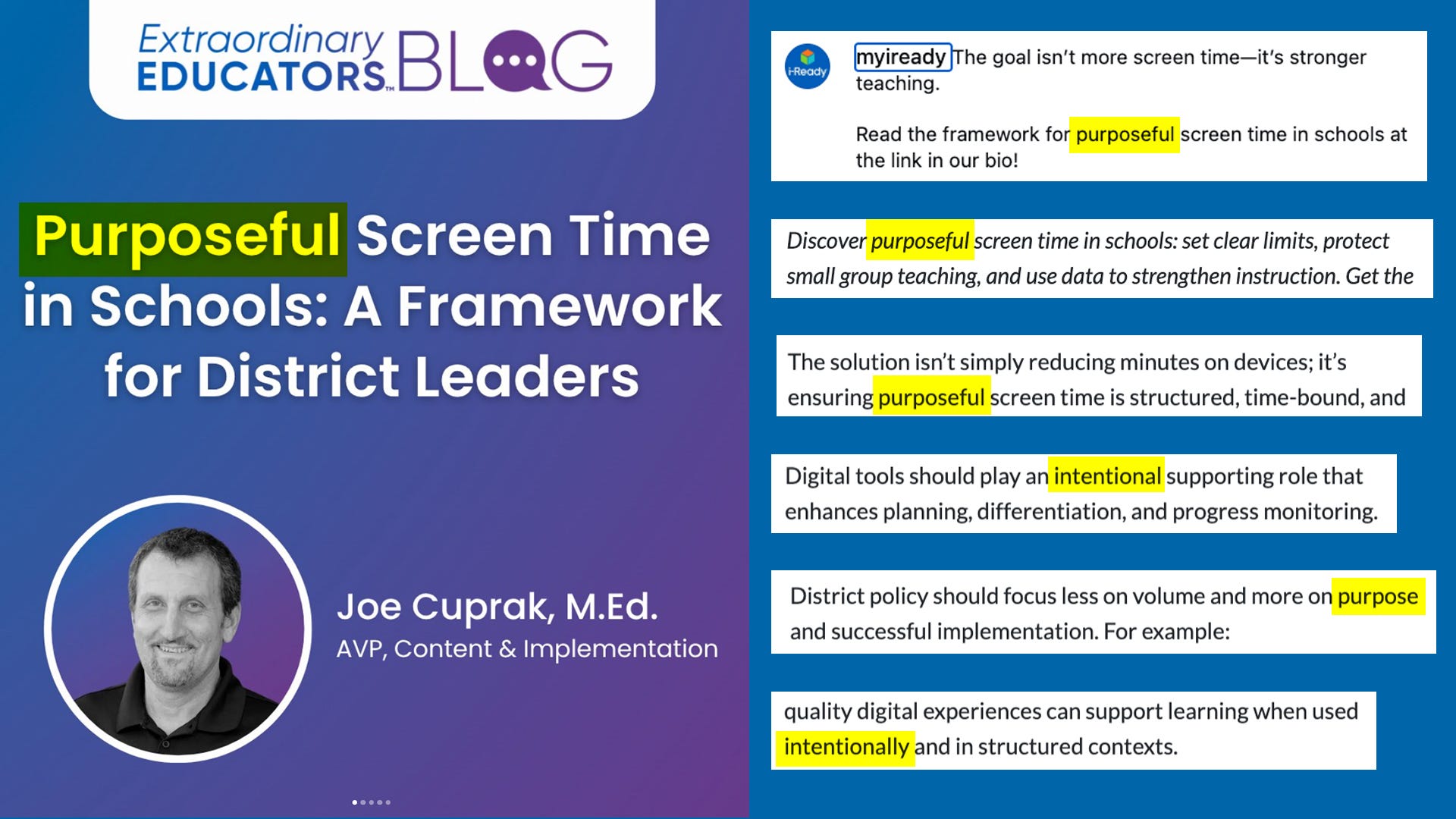
With “purposeful” screen time, i-Ready’s publisher is deploying a classic spin doctor rebranding technique: when cigarettes were first revealed to cause lung cancer, tobacco companies quickly became fluent in “all-natural” and “low-tar.” When consumers were repulsed by genetically modified organisms (GMOs), big agriculture rechristened them as “bioengineered.” When Olestra-drenched WOW! potato chips gave millions explosive “anal leakage,” Frito-Lay discovered — oh wait, no, they promptly yanked that poison off the market. Today, i-Ready is to children’s brains what WOW! potato chips were to '90s snackers’ undies: a real shit-show.
Gaslighting With “Limited” Screen Time Lies
Vastly more egregious than CA’s college poetry seminar spin on screens themselves is their blatantly revisionist take on the “time” part of “screen time,” which in 2026 suddenly asserts that “limited” use of i-Ready is “what we’ve believed all along.”
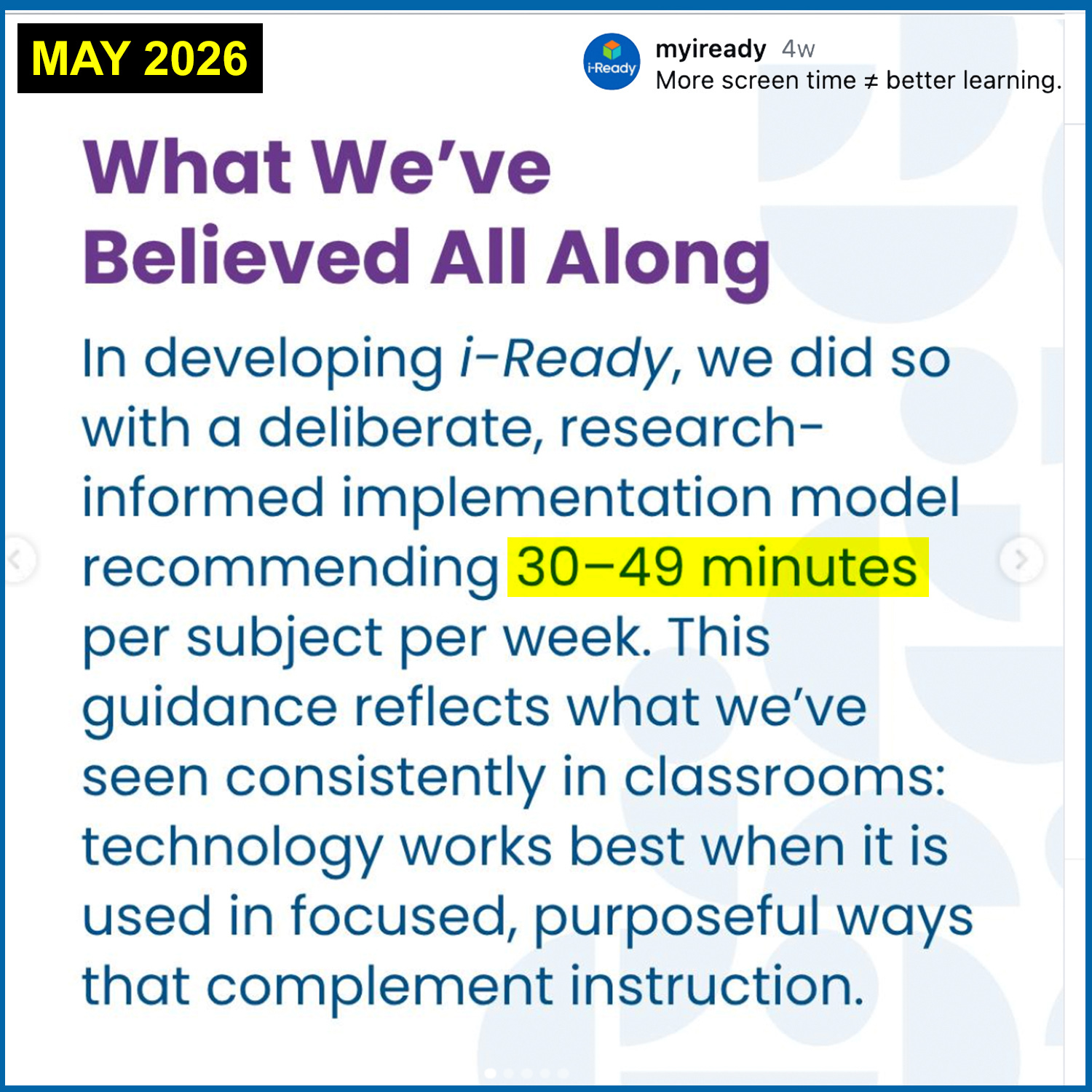
But any i-Ready parent or teacher (and the Internet Archive) can confirm that for many years, all Curriculum Associates documentation called for strict student “Time-on-Task” tracking — demanding a hard usage floor of “45 minutes or more per week, per subject” to ensure “implementation fidelity.” But suddenly, in 2026, when every minute of screen time now represents a severe corporate liability? Curriculum Associates shamelessly attempts to reduce the screen time floor by 50%, stressing just 30 minutes will suffice — a jaw-dropping switcheroo that verges on fraud.
Indeed, Curriculum Associates’ self-published 2021 research brief, “Impact of Time and Lesson Pass Rates on Student Learning Gains” neatly exposes the bald-faced lie that the company has “always” prioritized “limited” i-Ready usage. It documents that in one study — spanning just one of i-Ready’s 14 years — over 1.1 million K-8 students were subjected to 50+ minutes of screen time per subject, per week, including a staggering sub-cohort of 410,168 Kindergarteners, 1st graders, and 2nd graders.
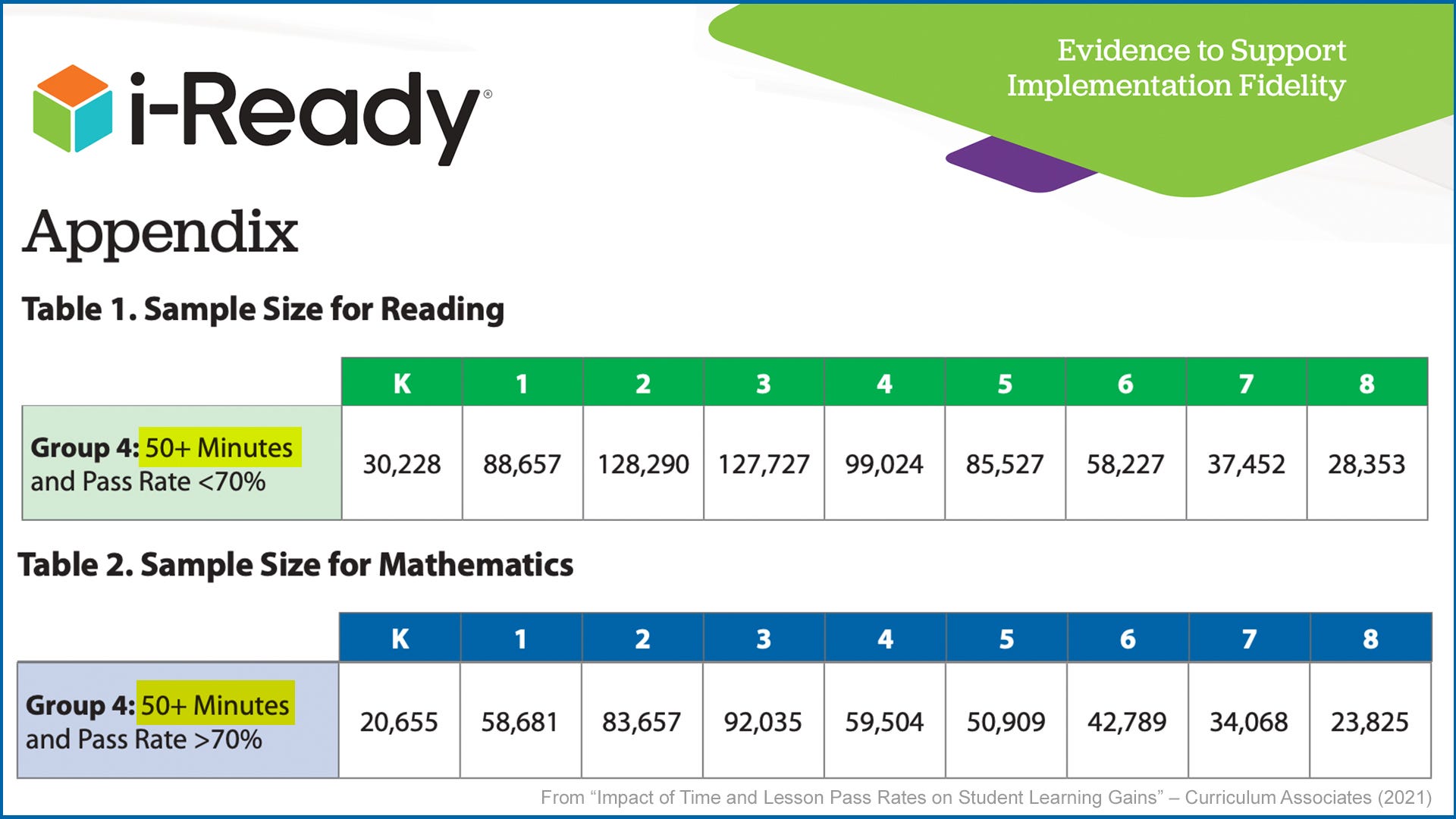
The brief, which Curriculum Associates routinely cites to encourage adoption of its oh-so-tellingly titled “Stretch Growth®” goals, concludes with an implicit exhortation to administrators to blow, er, stretch past the nominal 49-minute guidance.
“Students who went above the recommended guidance and used i-Ready for more than 50 minutes per week… experienced greater growth than students who met the recommended guidance”
Unsurprisingly, as detailed in Part One of this series, at districts whose hoodwinked superintendents guzzle the “Stretch Growth®” Kool-Aid, i-Ready usage often skyrockets into hours, each and every day.
Time for Video Games, Too
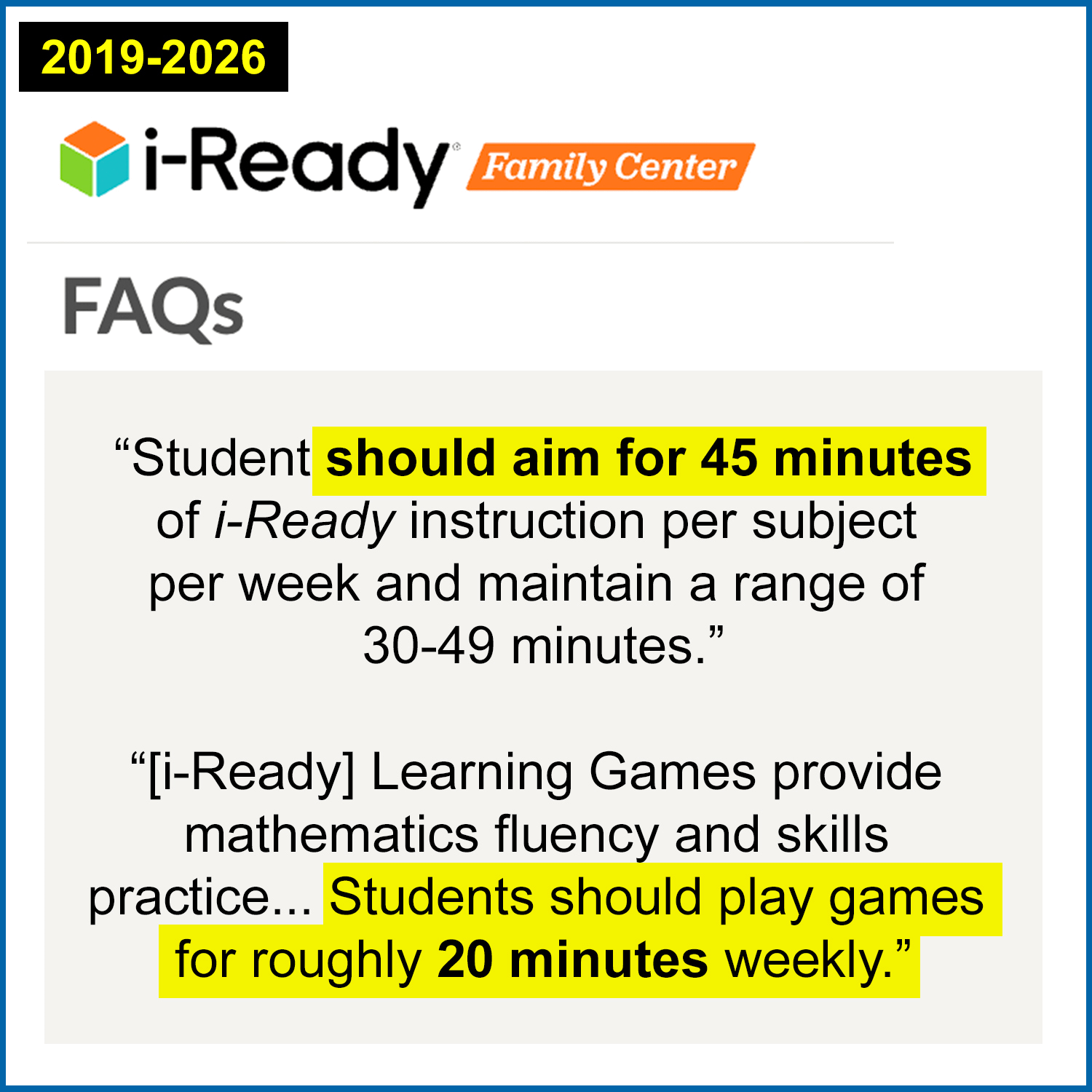
But in the Spring 2026 scramble to sanitize all i-Ready collateral to reflect the bogus new “limited” screen time narrative, CA also overlooked its “Family Center.” This longstanding guide for parents on how best to jack the kiddies into i-Ready at home, invokes the platform’s integrated arcade of infantile “learning” video games, and explicitly tells moms and dads to assign 20 additional weekly minutes of video gaming.
Minimum 45 Min. Math + 45 Min. English + 20 Min. Games ≠ 30 Mins
The Proof is in the Product
But whatever Curriculum Associates’ contradictory written screen time limits, just one glance at the product itself makes the company’s gaslighting laughably obvious. i-Ready’s student dashboard interface is dominated by an oversized circular gauge guiding kids not towards 30 or 45 minutes, but a full 60+. YouTube abounds with videos of teachers pressured to deliver over one hour per student, and frustrated kids toiling towards onerous “Time-on-Task” mandates — even in excess of four hours.
For all CA’s historical emphasis on maximizing the screen time they now attempt to conceal, many experts were never sold. Justin Reich, Director of MIT’s Teaching Systems Lab and author of Failure to Disrupt, told me “I don't think there's great evidence from i-Ready that when people use it for the recommended amount of time, they get the results that they want.” Asked whether school administrators should have faith in i-Ready’s own measurements of student progress, he replied “I don't have a lot of confidence in any organization that says, ‘We've built a thing and looking at our own internal metrics, it's working great.’ Of course they're going to say that.”
The i-Ready Backlash Gets Real
Stepping into Curriculum Associates’ sensible shoes for a moment, given the magnitude of their current inescapable catch-22, the temptation to bend the truth is understandable. After all, people panic. (And in America, corporations are people, too!) But to do so in 2026, after generating a 14-year paper trail that you’ve actively distributed to millions, and which remains instantly accessible at the click of a mouse? That represents a level of professional ineptitude and mendacious stupidity that almost defies imagination.
But Curriculum Associates has good reason to be panicking. After a smooth, quiet rise to colonize America’s classrooms and plug millions of children into the i-Ready matrix, the company now finds itself facing a litany of existential threats.
A 2025 federal class-action privacy lawsuit filed against CA in Massachusetts continues to move forward; in February the company smeared the plaintiffs as zealots on an “ideologically motivated crusade” in an unsuccessful motion to have the case dismissed. With blood in the legal waters, Curriculum Associates knows more lawsuits are likely to follow — and they won’t be limited to boring privacy concerns.
As parents across America storm school board meetings demanding i-Ready be purged, Curriculum Associates’ most lucrative contracts are in jeopardy. In April, bowing to pressure from parent group Schools Beyond Screens, Los Angeles Unified — perhaps CA’s largest customer as the country’s second largest district — voted unanimously that i-Ready would no longer be used for grades K-2 (23% of students) as it reviews all its ed-tech contracts. Soon after, Washoe County School District, Nevada’s second largest, radically scaled back a planned three-year i-Ready contract renewal to just one year. Local news reported the board only refrained from scrapping the platform altogether because it would be “chaotic because they do not have a replacement available.” Given the education community’s well-documented herd mentality, more big i-Ready financial dominos are poised to fall.
Noting Curriculum Associates’ private equity backing, Drew Kerr believes any subsequent revenue hits would spell trouble for the company’s leadership. “Some drastic action will be taken, because private equity doesn’t want to see their investment tanking,” he said. “The CEO’s head might roll, too.”
i-Ready Regulation?
And yet all that market-driven peril may end up paling in comparison to what could be coming legislatively. In May 2026, the otherwise Big Tech-smitten Trump Administration produced a document that doubtless landed at i-Ready HQ like a bag of those WOW! Doritos.
The U.S. Surgeon General’s Warning on the Harms of Screen Use explicitly categorized the exact hardware delivery methods utilized by i-Ready as a vector of cognitive and behavioral harm to minors, and advised schools to return to physical, pen-and-paper curricula. In its introduction, Secretary Robert F. Kennedy Jr. implores Americans, “Let’s turn our screens off and our brains and bodies on, so that we can live real life.”
In light of the Federal government’s new official stance on screens, and given the overwhelming bipartisan popularity of school phone ban legislation, it’s not hard to imagine lawmakers’ regulatory attention soon pivoting to ed-tech. With i-Ready’s massive market share and singular detestability, Curriculum Associates knows it could well end up being first in the proverbial barrel.
I reached out to Curriculum Associates repeatedly to inquire whether they will add a prominent public health warning label to i-Ready’s user interface, or issue a full product recall — particularly for their millions of K-2 users, whom the Surgeon General’s office notes are at the most acute risk. Curriculum Associates did not respond.
End Game
Whatever “purposeful” and “limited” screen time lies Curriculum Associates deploys to distract from the insurmountable paradox that i-Ready “learning” harms children’s cognition by sheer virtue of being screen-based, many teachers aren’t buying it; they’ve seen the effects of digital learning’s rise first-hand, every day.
“Mr. J,” a 20+ year veteran second grade teacher in West Virginia, told me he has seen dramatic negative changes in his students over the years that i-Ready screens have taken over his classroom. “They have less ability to communicate, to interact, to learn from one another, to teach one another, to care about one another or have empathy,” he said. “Their worlds get smaller and smaller so that everything's on that screen. That is disgusting and it scares me. And it's definitely the opposite of the reason I went into education.”
That could change soon. The US Surgeon General’s screen time advisory may be the catalyst for finally scrutinizing ed-tech not through an educational efficacy lens, but a public health one. And in that light, it’s not hard to discern a future when i-Ready is no more — shelved alongside lawn darts and thalidomide in the museum of child-focused catastrophes.
###
POSTSCRIPT: Here’s wishing a warm welcome to my three new subscribers from Heller Communications — the OG mack-daddies of high-stakes corporate reputation triage! Heller has previously spun sunny, humanizing PR narratives for such upstanding convicted felons as the Oxycontin-peddling Sackler Family, crypto-cretin Sam Bankman-Fried, and even snuggly old Harvey Weinstein himself! Substack analytics reveal Heller employees are super-engaged with the i-Ready i-Reckoning series. I reached out to these subscribers to inquire whether their firm has been retained by Curriculum Associates or its private equity investors. Heller Communications did not respond.

ALL THE WORLD LOVES A WHISTLEBLOWER! Are you a current or former Curriculum Associates employee, consultant, partner or vendor? If you have information regarding the development of i-Ready and its impact on children that you feel morally or ethically compelled to share, please contact me. Your identity will be kept confidential.
FOLLOW THE PODCAST
Apple | iHeart | Podchaser | Spotify | YouTube
i-Ready i-Reckoning: The Epostasy Investigative Series
Part 1:

Part 2:

Part 3:

Part 4: (You’re soaking in it now, Madge.)
Part 5: Coming Soon
About John Allen Wooden:

Howdy. I’m a tech-traitorous writer, satirist, creative director, and dad based in Los Angeles. Having done hard time in big online media, late night TV, ad agencies, politics, and parenting, I created Epostasy as my little lab for gleefully dismembering all those self-important things. Check out my tech-skeptical kids book series, Screen Time Tales, along with other projects at johnallenwooden.com

Appreciate this John. So scary to see the marketing spin done in the name of helping kids. People sometimes ask me how do these deceptive CEOs and marketers sleep at night? I find myself replying, "On very fancy sheets in a fancy house." People will do so much for a dollar--even if it hurts kids.
🔥Thank you for telling the truth, John, and for exposing the myriad harms of EdTech in schools. As someone who has taught in middle and high schools over the past decade plus, what I’ve witnessed in our screen-saturated classrooms has become increasingly disturbing. It’s time to get back to analog learning methods that we know work: paper, pencils and people!!