


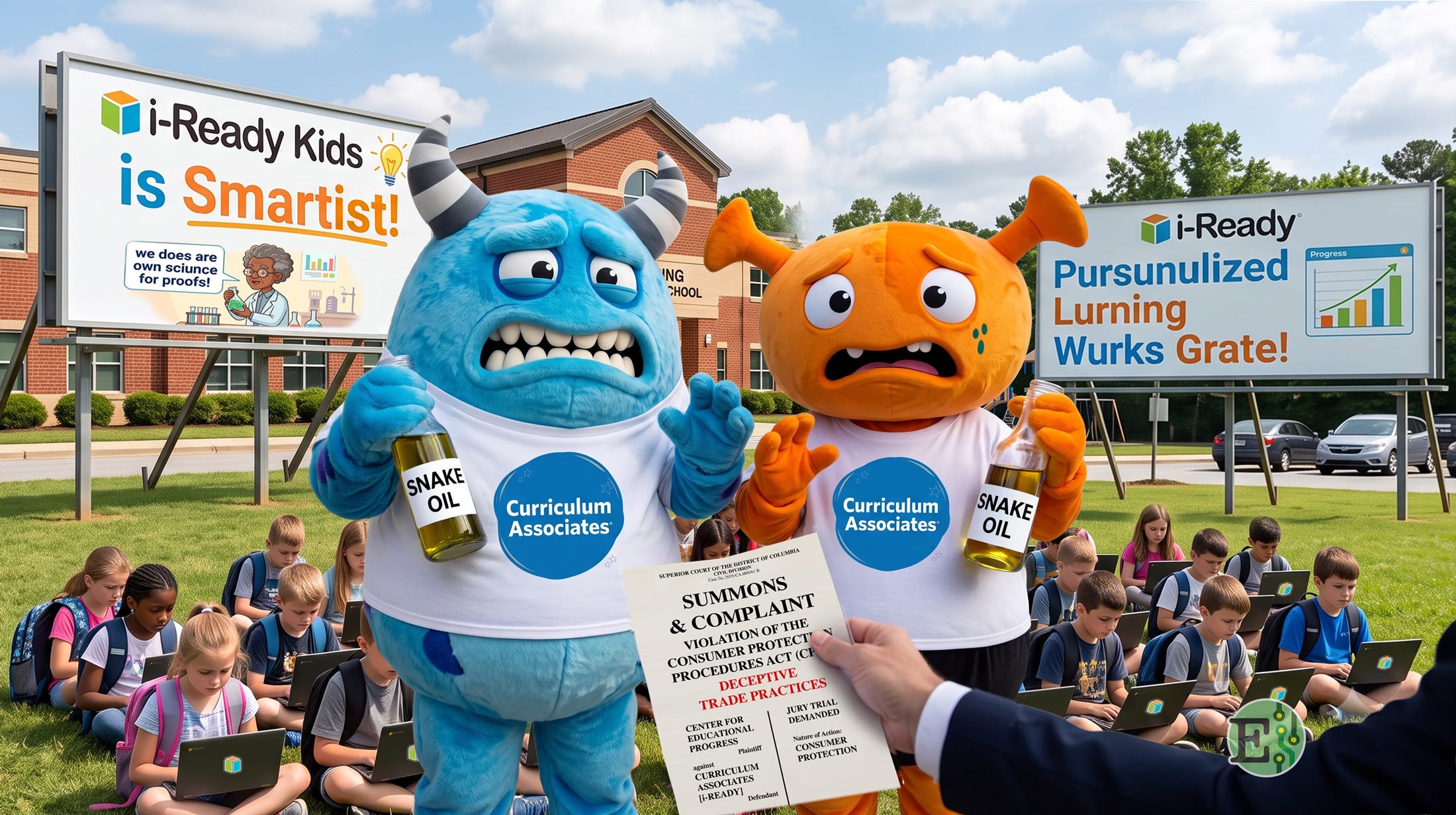
Curriculum Associates, the ed-tech publisher of ubiquitous classroom gerbil wheel i-Ready, is facing a new theatre of legal woes: this time over false advertising claims that its product is educationally legitimate. In a landmark lawsuit filed July 31st in Washington D.C., plaintiff Center for Educational Progress (CEP) cites original reporting from the i-Ready i-Reckoning series in alleging that Curriculum Associates violates the Consumer Protection Procedures Act (CPPA) by using “innuendo and ambiguity” to “mislead reasonable consumers,” and harms children by squandering unrecoverable instruction time with its “crude screener” product whose proof of efficacy is dishonestly “measured on a loop of its own making.”
Noting that i-Ready is “the most widely deployed K–8 educational-technology product in the United States,” CEP v. Curriculum Associates declares that i-Ready marketing is false and deceptive because “the studies Curriculum Associates markets as proof… draw on Curriculum Associates’ own data” — noting that all such so-called proof is essentially “Curriculum Associates’ test of Curriculum Associates’ lessons,” in which the self-dealing defendant “writes the test, supplies the lessons, generates the data, and grades the result.” This is the same closed-loop evidence system I first revealed as “An Unproven Triumph of Science-Washing” in Part One of this series — which is cited as an exhibit within the lawsuit.
Thomas Briggs, Director of Operations at Center for Educational Progress, framed the lawsuit as a long-overdue reality check for an ed-tech profiteer peddling lies, telling me: “Curriculum Associates sold a product to D.C. schools and D.C. families and students as being a real diagnostic, actually being personalized, and backed by research—and they’ve made a lot of money because of those misleading or false claims. We think that D.C. taxpayers are entitled to damages, and to stop being falsely advertised to.” CEP is a Washington DC 501(c)(3) nonprofit whose declared mission is “protecting consumers, students, families, classroom teachers, and the taxpaying public in the nigh-unregulated educational technology market.”
CEP v. Curriculum Associates shines a spotlight on the bogus in-house “research” which is the foundation of i-Ready sales and marketing — willful, premeditated, and lavishly funded science-washing efforts borne entirely of internal corporate strategy.
In its complaint, CEP argues that Curriculum Associates violates Washington D.C.’s Consumer Protection Procedures Act (CPPA), which guarantees consumers a right to truthful information from merchants, by making multiple deceptive claims in its marketing:
A “Diagnostic” Fraud: CEP points out that the “i-Ready Diagnostic” is not a true diagnostic at all, declaring the product is analogous to “the difference between a check-engine light and a mechanic’s report. A check-engine light tells you something is wrong. A diagnostic tells you what is wrong. In essence, Curriculum Associates sells the light and calls it the report.”
“i-Ready does not let teachers see the questions their students answered, the questions they missed, or why. The most a teacher can learn is that a child scored poorly in a broad domain—with little to no way to determine whether the child misunderstood the particular question, the underlying skill gap, or the broader concept.”
- CEP v. Curriculum Associates
(Tellingly, in apparent awareness of this liability, Curriculum Associates rebranded “i-Ready Diagnostic” as “i-Ready Inform” in late 2025.)
A “Personalized Learning” Fraud: Validating widespread complaints from educators that i-Ready routinely assigns screen-based lessons that are wildly inappropriate for students’ actual mastery levels, CEP documents how i-Ready’s promise of “personalized learning” is in fact “not tailored to any student’s actual skill level” and assigns “the same generic lesson sequences to students with materially different specific skill gaps.”
“Because i-Ready does not adapt to a student’s actual skill, a child who has already mastered a concept is marched through it again, lesson after lesson… forcing students monotonously through long, text-heavy worked examples narrated in plodding, extreme detail before the child may answer a question the child could already answer. Multiplied across three sittings a year and an entire District of K–8 students, that is the systematic waste of the instructional time the District licensed i-Ready to save.”
- CEP v. Curriculum Associates
A “Fidelity” Fraud: CEP’s filing highlights Curriculum Associates’ use of popular ed-tech guidelines (see also: IXL, Dreambox, Amplify, et al.) that its product should be used “with fidelity” — meaning students must meet minimum i-Ready screen time thresholds. The suit denounces this as a contractual “escape hatch” which “shifts the risk of underperformance onto students, families, and teachers” — and points to CA’s practice of producing self-authored, science-washed “evidence” which omits negative outcomes by reporting exclusively on test scores of students who clock maximum i-Ready screen time.
“When schools do not see the promised gains, Curriculum Associates attributes the shortfall not to the product but to insufficient “fidelity”—to students who did not use the platform enough, families who did not enforce it, or teachers who did not police it. The independent ‘with fidelity’ studies confirm the maneuver: favorable findings are reported only for students who met Curriculum Associates’ own recommended usage levels.” - CEP v. Curriculum Associates

CEP v. Curriculum Associates further complains that ed-tech products like i-Ready have essentially been given carte blanche to colonize Washington D.C.’s classrooms because “no federal labeling regime, no FDA-style efficacy review, and no comprehensive state oversight operates to ensure that vendor claims are truthful.” In establishing standing to file suit under the Consumer Protection Procedures Act, the plaintiff asserts, “Curriculum Associates’ deceptive marketing of i-Ready is exactly the kind of conduct CEP was organized to expose, document, and counteract, and the consumers i-Ready harms are the consumers CEP exists to serve.”
The suit is filed on behalf of all District of Columbia School District (DCSD) K-8 students compelled to use i-Ready products — including their parents or caregivers. It seeks a permanent injunction prohibiting Curriculum Associates from “deceptive and unfair trade practices,” and demands the defendant be required to run “corrective advertising” and disclosures on i-Ready products. It also seeks refunds of millions of dollars in i-Ready licensing fees paid by DCSD, and damages of $1500 per violation. With approximately 30,000 K-8 students presently enrolled in DCSD, that could translate into damages exceeding $240 million.
This marks the second suit filed against i-Ready’s publisher in just eight months. The first, class action M.C. v. Curriculum Associates, was filed in Massachusetts federal court in late 2025, and accuses the company of violating child-privacy laws by conducting digital surveillance on minors in their own homes to create “highly intimate academic and psychographic profiles of children.” That case remains active, with CA strenuously denying its allegations, despite i-Ready’s fundamental reality of being an always-on, compulsory, Internet-connected product designed for industrial-scale harvesting of children’s personally identifiable data.
If and when CEP prevails in court, it will set legal precedent that is virtually guaranteed to unleash a tsunami of litigation across the country, condemning Curriculum Associates and its fellow ed-tech charlatans to the same existential reckoning now confronting their kissin’ cousins in Big Social Media.
But lawsuits focused on child privacy violations let Curriculum Associates and other ed-tech corporations wield a defense that essentially argues, “mass data collection is just how the interweb works” — asserting that their privacy violations represent but a minuscule, irrelevant side effect of the format of an entire industry. They argue, in effect, “You can’t blame a book publisher for paper cuts — even if we use razor blades for pages.”
CEP v. Curriculum Associates, however, shines a spotlight on the bogus in-house “research” which is the foundation of i-Ready sales and marketing — willful, premeditated, and lavishly funded science-washing efforts borne entirely of internal corporate strategy. It will litigate the actual content of the mendacious, self-authored “evidence” and bought-and-paid-for commissioned studies with which Curriculum Associates has successfully hoodwinked naïve school district procurement officials into signing multi-million dollar contracts.
Moreover, CEP’s lawsuit, while specific to Curriculum Associates and D.C. Public Schools, touches on the core business practices of the entire unregulated ed-tech industry, which plays egregiously fast and loose with unproven pedagogical claims, officiously camouflaged with oceans of meaningless data, while it conducts a vast, reckless cognitive experiment on millions of helpless American children.
If and when CEP prevails in court, it will set legal precedent that is virtually guaranteed to unleash a tsunami of litigation across the country, condemning Curriculum Associates and its fellow ed-tech charlatans to the same existential reckoning now confronting their kissin’ cousins in Big Social Media.
And won’t that be just peachy to watch? So stay tuned, Epostates — it’s going to be one hell of a school year!

Support EPOSTASY: Buy Post-Tech Swag

About John Allen Wooden:

Howdy. I’m a tech-traitorous writer, satirist, creative director, and dad based in Los Angeles. Having done hard time in big online media, late night TV, ad agencies, politics, and parenting, I created Epostasy as my little lab for gleefully dismembering all those self-important things. Check out my tech-skeptical kids book series, Screen Time Tales, along with other projects at johnallenwooden.com

i-Ready is like the creepy neighbor who you just don't feel right about them being anywhere near your kids.