


One of the most tedious symptoms of today’s infantile culture wars is the conviction—held by censors on both the right and the left—that children can be harmed by reading the wrong stories. Book banners and cancel mobs may loathe one another, but they share a slavish devotion to ideological purity and a smoldering suspicion of ambiguity—especially when lizard brain parenting instincts kick in. As a recovering tribalist myself, I confess that I long indulged those impulses too, until I accidentally gifted my child a book that ran exactly counter to my own values—and it blew up in my face in the very best way possible.
It all started one day when my daughter came home from first grade with a burning question about a classmate: “Rosie has four moms. How did she get so many?” My wife and I looked at each other in surprise, not out of fear over some nefarious LGBTUVWXYZ+ plot to indoctrinate our innocent child, but because after years of living in sexuality-diverse cities, it just hadn’t occurred to us that she’d take note of such things. Assuming her puzzlement was borne of the sheer number of parents rather than their chromosomes, we matter-of-factly explained that Rosie’s mother had divorced her first wife, but both had remarried. Boom—four moms. We figured that would be the end of it.
But not long after, our daughter again expressed bafflement upon learning that another classmate had no mother at all—just two dads. And so we gently reminded her of our various family and dear friends who are gay, and how it’s just the same situation. She seemed to understand, but that was when my lifetime of liberal sensitivities kicked into overdrive. Worried that perhaps she might innocently say something at school that could hurt another kid’s feelzies, I decided the situation called for a little more proactive imparting of our family’s values.
But then my parental wisdom train went careening off the rails—because as it turned out, my memories of Arlo the Dandy Lion were catastrophically incomplete. Somehow I’d completely forgotten the book’s entire second half (and true message).
Since we were already reading bedtime stories aloud every night, reinforcing a lesson of inclusivity via a picture book seemed a no-brainer. So I started browsing some of the go-to modern kids’ books that tackled the topic at hand, like Heather Has Two Mommies and Daddy’s Roommate. But while the free-speech absolutist in me relishes supporting any book banned by judgy prigs, those titles just seemed too on-the-nose and preachy. I wanted something less obvious, more issue-adjacent, and with a stiff shot of humor and subversiveness—because yes, I am an incorrigible man-child.
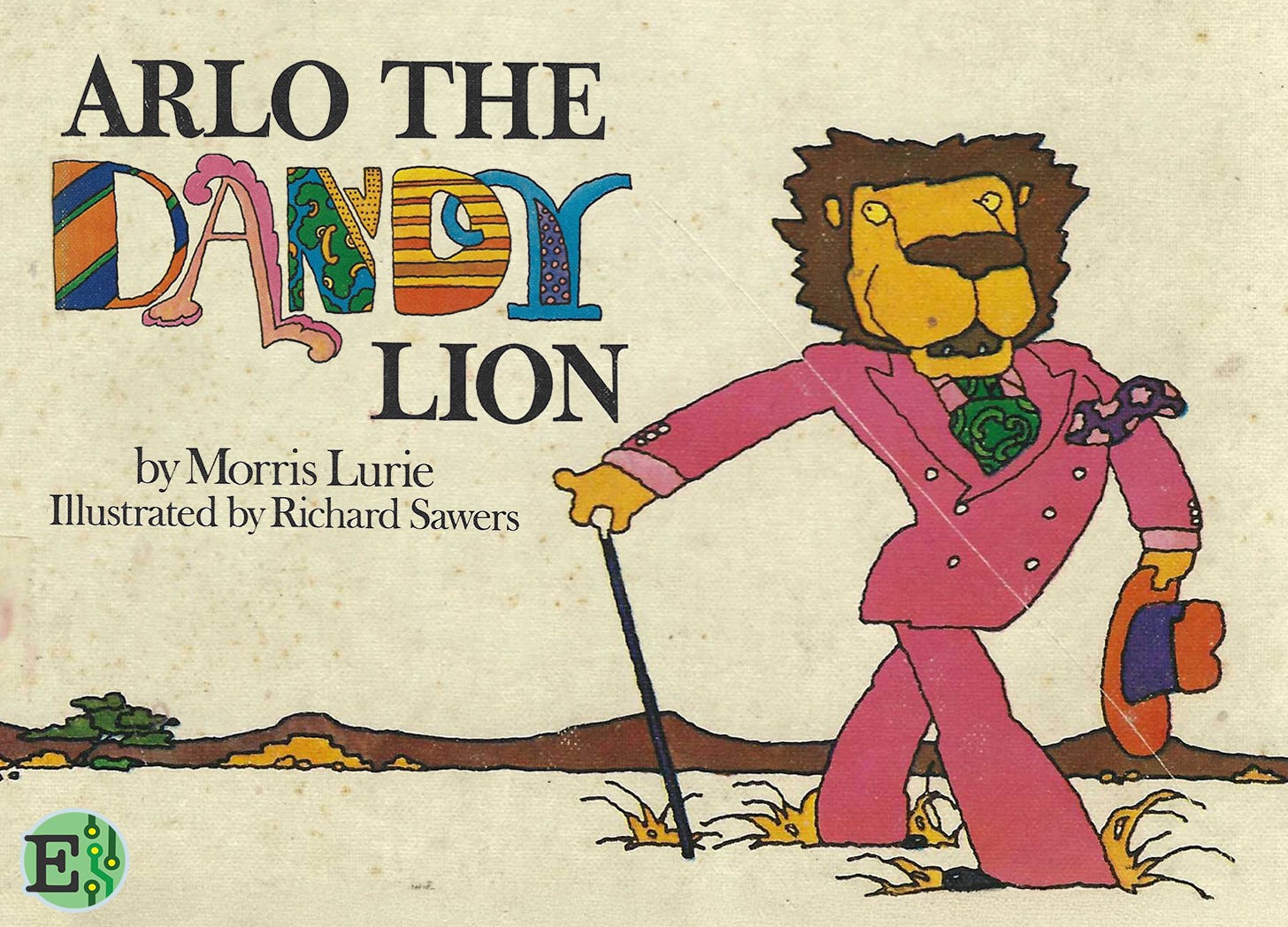
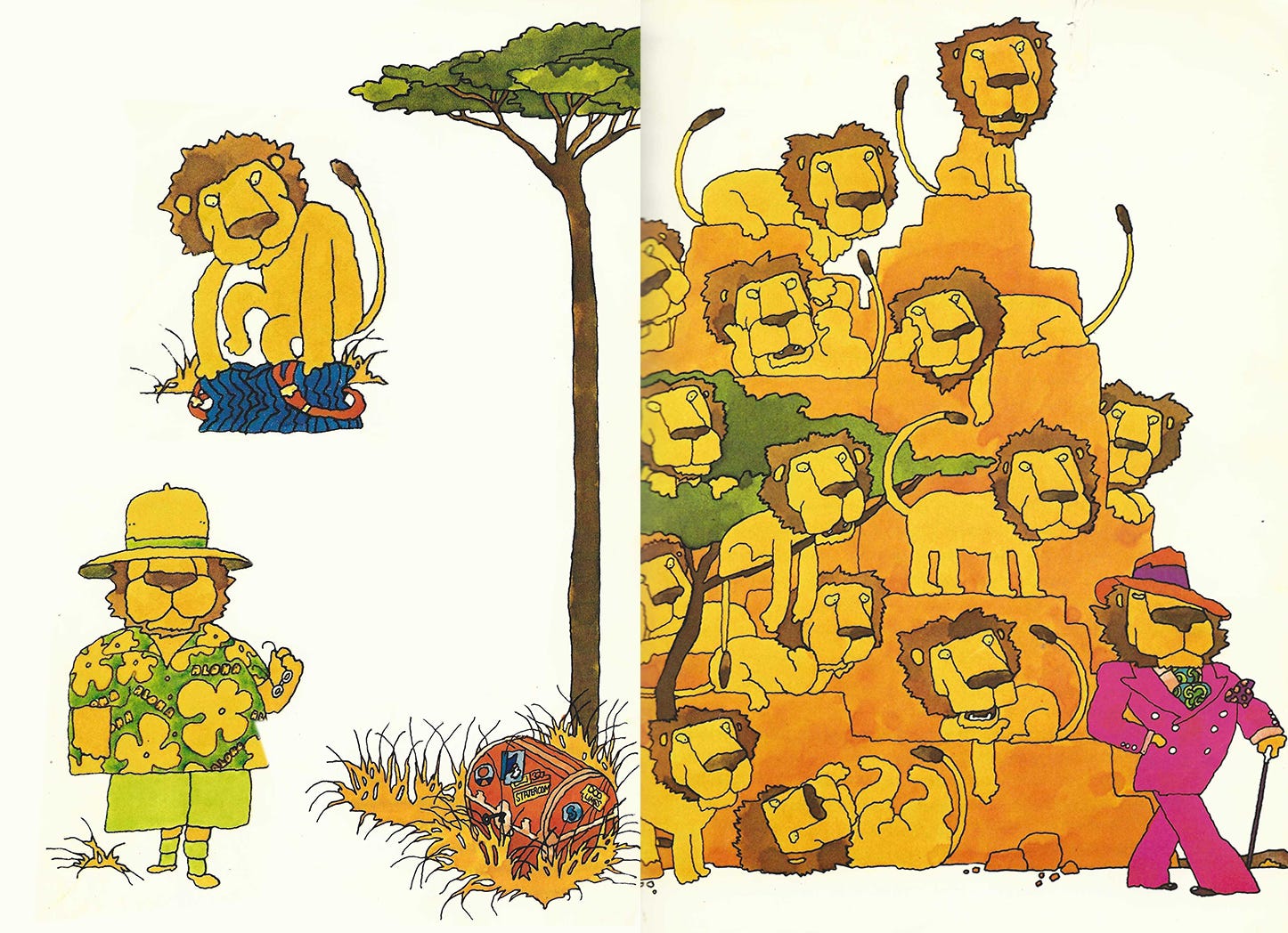
That’s when I remembered a picture book from my own youth that might do the trick: Arlo the Dandy Lion by Morris Lurie (McGraw Hill, 1971). I hadn’t read it in 30+ years, but my memories were vivid. It’s the story of Arlo, a young lion living on a remote savanna, who happens upon a large red trunk left behind by humans. Inside, he discovers a veritable haberdashery of stylish duds, and has a grand time paying dress-up in colorful ensembles. I clearly remembered the vibrant illustrations of Arlo proudly strutting in a velvet suit while twirling a walking stick, totally unshaken by the other lions’ disapproval. So complete was Arlo’s transformation, I recalled, that a human on safari confused him for an all-new species called a Poppelhoop, and flew him to the big city, where he was welcomed by millions of adoring fans. I remembered Arlo as a playful metaphor for gender-bending non-conformity, and with the holidays fast approaching, I decided to get a copy for my daughter.
Popping over to Amazon, I was surprised to find Arlo the Dandy Lion long out of print. And so I went to eBay, where there was just one copy: an old public library cast-off. It was tattered and over-priced, but I ordered it. When the book arrived in the chaotic days immediately preceding Christmas, I quickly inscribed and wrapped it, and slipped it under our tree. This wouldn’t be a gift from Santa; I imagined this rediscovered artifact from my childhood becoming a family keepsake, and my little girl developing fond memories of us reading it together while internalizing its message of benevolent inclusion. Verily, I would be Dad of the Year!
At bedtime that Christmas Day, we pulled Arlo the Dandy Lion from among my daughter’s new gifts and crawled into her plushy-strewn bed to start reading our nightly story. To preemptively eliminate any question about the important lesson we’d be taking away, I proudly read my book inscription aloud:
To S,
Always remember:
Different = Good!
Love, Dad
X-Mas 2012
Diving into the story, the book’s opening pages conformed exactly to my memories. The bold, hippie-inspired illustrations by Richard Sawers strongly resembled his earlier work in The Beatles’ Yellow Submarine. There was Arlo on the African savannah, finding the big red trunk full of fun and flashy clothes. And there was Arlo confidently twirling his walking stick while all the other lions looked on aghast.
My girl and I were a little taken aback, however, when the other animals began taunting the snazzily-dressed Arlo, saying he looked “ridiculous” and “foolish.” My daughter cried, “they’re being mean!”, so I reminded her of a recent chat we’d had about how kids’ content has changed, and how this echoed the retrograde bullying in 1964’s Rudolph the Red-Nosed Reindeer. She was reassured when I reminded her that in the end, Rudolph’s differences were celebrated. Our inclusivity discussion may have been starting a little differently than I’d envisioned, but so far, so good!
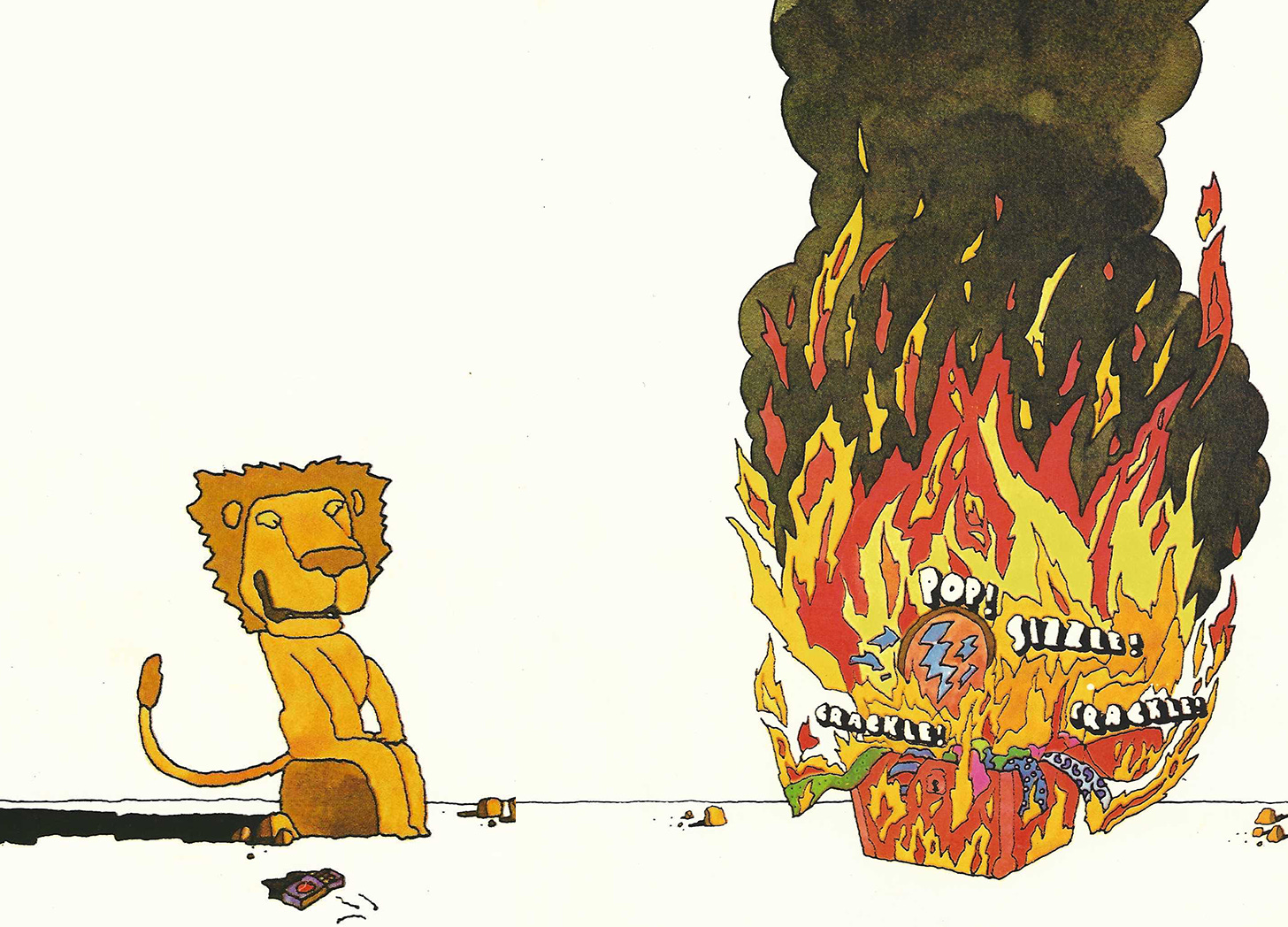
But then my parental wisdom train went careening off the rails—because as it turned out, my memories of Arlo the Dandy Lion were catastrophically incomplete. Somehow I’d completely forgotten the book’s entire second half (and true message): After being imprisoned in a London zoo, Arlo initially enjoys all the attention. But when winter arrives, the crowds disappear, and he shivers in the frigid snow—lonely, miserable, and too emasculated to even conjure a roar. Eventually Arlo’s once-jaunty velvet suit disintegrates, and when he’s revealed to be just another lion, he is promptly exiled back to Africa, where upon being reunited with his pride, Arlo immediately asks for the trunk of clothes—his cherished gateway to escaping the crushing sameness of cultural conformity—and sets it ablaze.
I was afraid I’d just inadvertently planted some dreadful psycho-philosophical seed—one that might land her a full-ride scholarship at Oral Roberts University. I also knew that online, there were legions of totalitarian cancel monkeys who’d equate what I’d just done to reading Mein Kampf für Kinder.
Once again capable of full-throated roars, Arlo watches with a beatific smile as the big red trunk burns—savoring every pop, sizzle, and crackle. And then he assembles the entire pride to repent for his nonconformity, confessing “all the terrible things that happened to a young lion who was vain and decided to wear clothes.”
Uh-oh. This wasn’t the message I’d sought at all. In fact, this felt mighty close to a thinly-veiled gay conversion parable. Not because the late Morris Lurie was writing about sexuality per se—but because the book treats flamboyant nonconformity as something to be corrected through ridicule, deprivation, and auto-flagellation. Indeed, “Dandy” in the book’s title doesn’t playfully connote style and verve like I’d remembered—it pejoratively hisses “Arlo the SISSY Lion.” The story’s subtext felt equally retrograde; it’s a judgmental cautionary tale about a conceited, narcissistic, and mockably effete freak, who got his just desserts for daring to deviate from the cultural norms of his pride and prance around like some little fruitcake! Worse, in the end, Arlo went back into his lion closet and lived happily ever after. Yeesh.
When we finished the book, my girl looked up at me confused. “Why did he burn the clothes?” she asked, “They were pretty!” At first I was too astonished to answer. I was afraid I’d just inadvertently planted some dreadful psycho-philosophical seed—one that might land her a full-ride scholarship at Oral Roberts University. I also knew that online, there were legions of totalitarian cancel monkeys who’d equate what I’d just done to reading Mein Kampf für Kinder.
So how had I gotten it so wrong? Well in fairness, the last time I’d laid eyes on Arlo, I was six and Jimmy Carter was president, so maybe I should’ve patted myself on the back for remembering as much as I did instead of fretting about early-onset dementia. Then again, Arlo the Dandelion is also over 5,000 words long—which by contemporary kids’ books standards is basically The Odyssey—so I probably didn’t even forget the second half; I’d probably just always fallen asleep in the middle.
Either way, what’s done was done. No, I never would have given Arlo to my girl if I’d remembered how it really ended, but what a happy accident it proved to be. My plan to serve up a bowl of simplistic polemical pablum was upended, replaced instead with a five-course meal of ideas. Yes, Arlo still prompted that discussion about valuing differences and not being a judgy jerk, but it also became a catalyst for a deeper conversation covering lots more territory: from the nature of memory, to shifting cultural attitudes over time, to the, um, colorful history of African safaris. We also found kernels of true value in Lurie’s narrative: sure, “vanity” may have been a metaphor for rigid old girl/boy social norms, but there was also some truth in his message—that Arlo’s infatuation with superficial appearance landed him in a lousy situation. Most importantly, we talked about how stories can have multiple layers of meaning—some good, some bad, but the best ones being…complicated.
And so our tattered old copy of Arlo the Dandy Lion did become a family keepsake after all. For my daughter, mostly as an amusing emblem of paternal fallibility—because Dad got things so idiotically backwards. But for me, it’s because our experience with it crystallized a core value I hope my kids embrace: never throw out the baby with the socio–political bath water. Books are good—even archaic ones that fail to flatter today’s sensibilities. Especially those.
Arlo the Dandy Lion wouldn’t stand a chance of getting published today, and that’s too bad. Well-meaning parents and editors, intent on protecting kiddos’ eggshell-fragile psyches, have increasingly narrowed children’s literary diets to gauzy, watercolored morality plays and anodyne tales of suffocatingly relentless positivity. But kids aren’t fragile; they’re perceptive and adaptable—and shielding them from ambiguity doesn’t make them safer—it just delays their ability to process it.
No, Arlo the Dandy Lion wasn’t banned or canceled—but it’s exactly the kind of “wrong story” that often is. Like many such books, it quietly fell out of favor and slipped into the lost-media abyss: a curious, forgotten artifact of cultural anthropology.
But don’t take my word for it. I scanned Arlo to PDF, so give it a read. Who knows what you’ll discover…
Happy New Year.

About John Allen Wooden:

Howdy. I’m a satirist, creative director, and dad based in Los Angeles. Having done hard time in big online media, ad agencies, late night TV, politics, and parenting, I created Epostasy as my little lab for gleefully dismembering all those self-important things. Check out my tech-skeptical kids book series, Screen Time Tales, along with other projects at johnallenwooden.com
You are a dad not the pope! What kind of parent isn't fallible? Thanks for sharing this amazing story.
"Well-meaning parents and editors, intent on protecting kiddos’ eggshell-fragile psyches, have increasingly narrowed children’s literary diets to gauzy, watercolored morality plays and anodyne tales of suffocatingly relentless positivity. But kids aren’t fragile; they’re perceptive and adaptable—and shielding them from ambiguity doesn’t make them safer—it just delays their ability to process it."
Yes! This is a huge pet peeve of mine. 90% of the books prominently displayed in the children's section of our library are the "watercolored morality plays" you speak of. And you wanna know something? They are excruciatingly boring. A perfect way to destroy a child's interest in reading and also in understanding whatever moral lesson the book is trying to bludgeon them with.